

You’re comparing agencies that all promise “affordable” marketing, but their offers may have little else in common. One proposal might cover social posts, another local SEO, and a third a complete lead-generation system with a website, paid media, analytics, and conversion work. The lowest monthly fee isn’t automatically the best value. Affordability depends on scope, contract flexibility, reporting quality, advertising spend, and your ability to turn inquiries into paying customers.
This list evaluates seven options by the budget problem each one solves: integrated local growth, social-first execution, turnkey management, local search, low-commitment support, lead-generation systems, or SEO-led planning. For each agency, consider the ideal business type, strongest channel, pricing transparency, implementation demands, limitations, and the next measurable step. Charlotte-area businesses should also use Queen City Digital as a relevant benchmark for integrated local SEO, conversion-focused websites, paid media, analytics, and ongoing optimization. If you’re coordinating campaigns with offline outreach, a client direct mail campaigns platform can help connect direct-mail activity with the wider customer journey.
Table of Contents
- 1. Queen City Digital
- 2. LYFE Marketing
- 3. Hibu
- 4. RevLocal
- 5. Main Street ROI
- 6. Comrade Digital Marketing
- 7. DAGMAR Marketing
- Top 7 Affordable Marketing Agencies, Comparison
- Turn an Affordable Retainer Into Measurable Growth
1. Queen City Digital
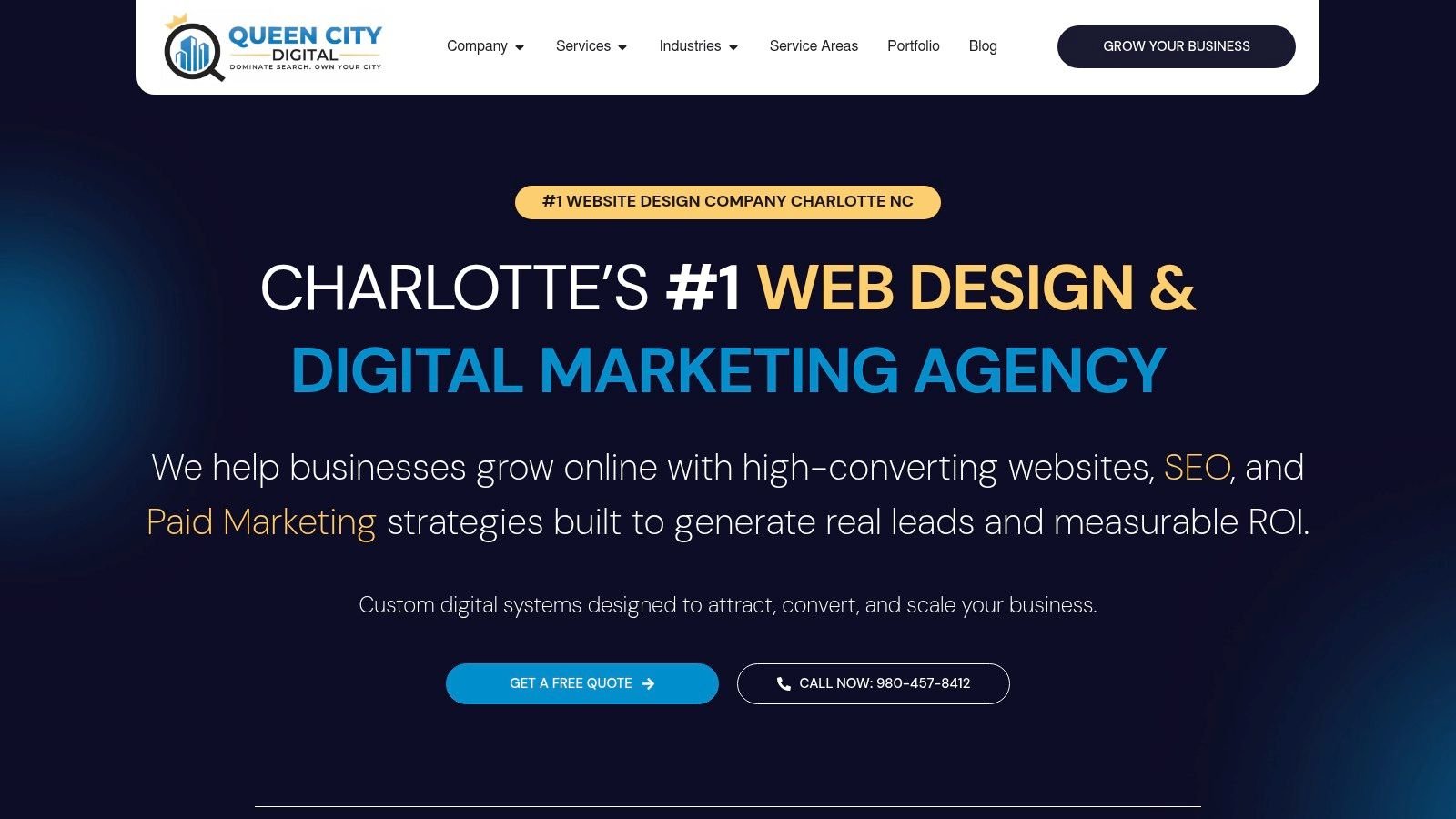
Queen City Digital solves the integrated local growth problem. A home-service contractor, medical practice, professional-services firm, or regional business often doesn’t need seven disconnected vendors. It needs a website that converts, visibility in local search, paid campaigns that generate inquiries, and reporting that shows what happened after someone clicked or called.
The Charlotte, North Carolina agency combines mobile-first web design with local and technical SEO, Google Ads and PPC, paid social, content, reputation management, email automations, analytics, and payment or POS integrations. Its Charlotte and Carolinas specialization also supports neighborhood-level keyword planning and Google Business Profile optimization, which is more practical for local operators than a generic national playbook.
Queen City Digital publishes four monthly packages: Essential Growth at $1,497 per month, Business Accelerator at $1,997 per month, Market Dominator at $2,997 per month, and Market Monopoly at $4,997 per month. These prices are provided by the agency’s own plan information in this brief, not by an independent pricing benchmark. The agency also advertises no long-term contracts. Its top tier includes a stated 90-day keyword ranking guarantee for up to 10 keywords in 3 locations, subject to the advertised terms.
Why it stands out
The strongest feature is post-launch accountability. Queen City Digital describes transparent KPI reporting, A/B testing, analytics configuration, and continuous optimization rather than treating a website launch as the finish line. Its documented social proof includes a luxury salon case study describing 300% more bookings and a private-school example involving full enrollment, claims supplied in the agency brief and not independently verified here.
The agency’s own background also cites approximately 90% client retention and more than 200 projects completed, again based on supplied publisher information. Treat these as agency-reported credentials and ask for the underlying case-study context before relying on them in a buying decision.
Practical rule: Ask which deliverables are included in your tier, which advertising costs are separate, and how every lead source will be tracked before signing.
For businesses that need more context, this guide explains how a small-business marketing agency can help your business grow. Queen City Digital is the clearest fit for Charlotte-area contractors, practices, legal and financial firms, local hospitality businesses, and regional B2B companies that want one partner responsible for the path from search visibility to qualified lead.
The limitation is straightforward. The fastest, most thorough work sits in the higher monthly tiers, while SEO and advertising results still depend on competition, keyword inventory, landing-page quality, and continued investment. Very small businesses should begin with one primary growth outcome and confirm that the selected package contains enough execution depth to affect it.
2. LYFE Marketing
LYFE Marketing solves the social-first execution problem. It fits a small business that needs consistent organic social content, community management, and paid social without assembling separate freelancers for creative production, publishing, and campaign management.
Its offer centers on social media management and advertising, with SEO, PPC, and email available to create a broader single-vendor stack. The agency’s in-house creative and community-management model is useful for businesses such as salons, fitness studios, restaurants, retailers, and visually driven service brands where regular content supports discovery and customer trust.
Visit LYFE Marketing to review its current services and onboarding path. The agency is known for publishing starter pricing for social packages, which gives owners an initial way to compare scope before a sales call. Confirm the current package details directly, especially the number of platforms, content formats, revisions, community responses, ad-management tasks, and reporting included.
The budget trade-off
LYFE is a good choice when social activity is a genuine acquisition or retention channel, not something the owner feels obligated to maintain. A social-heavy plan can become wasteful if your customers primarily search Google for urgent services or if your business lacks the visual assets needed to sustain useful content.
- Choose it for: Organic social management, paid social campaigns, in-house creative, and approachable onboarding.
- Confirm before signing: Posting frequency, video responsibilities, approval deadlines, ad-spend separation, and whether SEO or PPC requires an upgrade.
- Avoid overbuying: Don’t pay for a heavy content cadence if local search, reviews, or conversion tracking is the core bottleneck.
The agency’s social-first DNA may also mean that complex multi-location SEO, advanced analytics, or intricate attribution needs custom work. For guidance on connecting social activity to inquiries and sales, review these social media marketing tips for small businesses in North Carolina.
A practical starting engagement should define one measurable action, such as tracked calls, consultation requests, booking clicks, or completed forms. If LYFE can tie content and paid campaigns to that action, its productized approach can make social management easier to budget. If it can only report posts, reach, and engagement, the offer may be active without being commercially accountable.
3. Hibu
Hibu solves the turnkey management problem. Owners who don’t want to coordinate a web designer, listings provider, review tool, and advertising specialist can use its one-stack approach to place those functions under one vendor.
The platform brings together website services, listings and Google Business Profile work, reviews, search and social advertising, and reporting. That breadth is useful for local businesses and multi-location brands that need their core digital presence established quickly and prefer a done-for-you relationship.
You can review the provider at Hibu. Unlike agencies with public monthly tiers, Hibu generally requires a custom quote. That makes the sales conversation especially important. Request a written breakdown of setup fees, recurring fees, advertising spend, hosting, creative work, reporting, cancellation terms, and ownership of the website, domain, listings, ad accounts, and review data.
A bundled platform is only affordable if you can leave with your digital assets and reporting history intact.
The main advantage is reduced coordination. A single dashboard can make it simpler to monitor listings, reviews, website activity, and campaigns, particularly for an owner who has no internal marketing manager. The national scale may also suit businesses operating across several locations or service areas.
The risk is limited visibility before the quote. Without a public rate card, you can’t compare Hibu’s offer from the website alone. User feedback is mixed in the plan notes, so read the contract closely and ask whether the agency or the client controls each account and asset.
For local businesses that rely on reviews, establish the operating process early. Decide who requests reviews, how staff receive the review link, who responds to negative feedback, and how those actions appear in monthly reporting. This resource on generating a Google review link can support that workflow.
Hibu is the right shortlist candidate for owners who value convenience over granular channel control. It isn’t the best fit if you want independent specialists, highly customized conversion testing, or complete ownership clarity without negotiating those details first.
4. RevLocal
RevLocal addresses the local search problem for businesses that depend on nearby customers rather than broad national reach. Its services can include Google Business Profile visibility, listing accuracy, review growth, paid advertising, websites, and social support.
Use it when calls, directions, bookings, and local inquiries matter more than general awareness. Contractors, clinics, franchise operators, restaurants, and retailers can benefit from a provider that coordinates several local channels. Strategist support also gives owners a human contact instead of requiring them to manage everything through a self-service dashboard.
Review the current offer at RevLocal. Package structures and terms can change, particularly after the Hibu acquisition referenced in the brief. Before comparing proposals, confirm the current relationship, cancellation terms, asset ownership, reporting, and included channels.
Match the scope to the local-growth problem
RevLocal is most useful when operational consistency across locations is the priority. Multiple listings require accurate names, addresses, phone details, service descriptions, categories, photos, and review processes. Those tasks support visibility, but they do not replace relevant service pages, clear conversion paths, or reliable lead tracking.
Ask for a plan that connects local activity to business outcomes.
- Best fit: Local businesses and franchises prioritizing map visibility, calls, directions, and review growth.
- Useful expansion: Paid search or social advertising when organic local visibility needs support.
- Reporting test: Request the exact monthly report and verify where qualified leads appear, not only rankings or profile actions.
- Scope check: Confirm whether the work includes ongoing optimization and testing, or mainly listings maintenance.
Local visibility is not guaranteed. Competition, profile quality, review activity, website relevance, and execution all affect results. Treat the proposal as a scope document, then ask which tasks are performed each month and how changes are evaluated.
Charlotte businesses should compare a broad multi-market package with location-specific work. The guide to ranking on Google Maps in Charlotte offers a practical standard for questions about neighborhood targeting, service-area pages, and Google Business Profile optimization.
RevLocal makes sense when local search is the main bottleneck and you want hands-on coordination. Choose another structure if the larger problem is a weak website funnel, advanced paid-media attribution, or aggressive testing across several channels. Keep the retainer affordable by paying for the local tasks tied to qualified inquiries, then add channels only when reporting shows they can support growth.
5. Main Street ROI
If your website works but your Google Ads account needs tuning, Main Street ROI offers targeted fixes without forcing you into a broad retainer. It fits owners who need focused SEO help, campaign guidance, training, or consulting before expanding their marketing operation.
The provider’s small-business focus suits foundational work. Possible projects include an SEO review, Google Ads tune-up, campaign advice, or training that prepares an internal employee to manage routine tasks. Review Main Street ROI for its current services, consulting options, and educational resources before requesting a proposal.
Use it to remove a bottleneck
Start with a defined problem. You might have a functioning website with weak page titles, poor service-area structure, inconsistent conversion tracking, or an underperforming Google Ads account. Paying for a specific repair keeps the budget focused and avoids adding channels your team cannot manage.
Choose the engagement based on the capability you need:
- Targeted execution: One-time technical fixes, starter SEO, Google Ads management, training, or internal capability building.
- Controlled commitment: Address one bottleneck first, review the result, then decide whether broader execution deserves more budget.
- Scope boundary: High-velocity paid media, heavy creative production, advanced conversion-rate optimization, and multi-channel analytics may require other specialists.
Ask for deliverables, review dates, reporting access, and ownership of the tools involved. If training is included, confirm whether the purchase covers live instruction, documentation, campaign handoff, or ongoing support. A low initial commitment has value only when your team can maintain the work afterward.
The trade-off is capacity. A business that needs constant creative testing, rapid landing-page production, complex attribution, or coordinated paid search, paid social, email, and SEO may outgrow a focused provider. Match the scope to your operating model instead of paying for capabilities you will not use.
For a broader explanation of how partners can support small-business growth, read how a digital marketing company for small businesses can help you grow faster. Main Street ROI suits an owner who wants to reduce risk with a narrow starting scope. Choose another structure when fragmented execution is already the main problem.
6. Comrade Digital Marketing
Comrade Digital Marketing solves the lead-generation systems problem. It targets service businesses that need SEO, PPC, Local Services Ads, reputation management, and conversion-focused web work connected to revenue rather than treated as isolated activities.
Its service mix is relevant to home services, legal firms, and professional services. The agency also offers AI-assisted search optimization, landing-page work, and a “Revenue Engine” style bundle, alongside à-la-carte services. Visit Comrade Digital Marketing to review the current starting points and determine whether the proposed bundle fits your acquisition model.
Compare lead quality, not channel count
Comrade’s published starting prices for individual services can make the initial conversation more productive. You can identify whether the agency is pricing SEO, PPC, Local Services Ads, reputation management, and conversion work separately or packaging them into a larger engagement.
The important question is what happens after the lead arrives. Request a tracking plan that distinguishes phone calls, forms, booked consultations, qualified opportunities, and closed revenue. A campaign that produces inquiries without qualification rules can create more administrative work without improving growth.
A bundle may exceed a micro-business budget, especially if the company is still validating its service area or offer. Start with the channel closest to the immediate bottleneck, then add conversion optimization or reputation work when the underlying lead flow can support it. Don’t buy every channel because the agency can provide it.
Comrade’s national scope can be an advantage for businesses with broader ambitions, but Charlotte-area buyers should ask for relevant local examples and a specific neighborhood or service-area plan. The agency’s CRO focus is valuable when the website loses prospects after the click. It matters less if the business has no reliable traffic source or cannot respond promptly to new inquiries.
Use the first proposal as an operating document. It should state the landing pages, campaigns, audience definitions, review process, reporting cadence, lead-quality criteria, and client responsibilities. If those items remain vague, a transparent starting price won’t make the engagement transparent.
7. DAGMAR Marketing
DAGMAR Marketing addresses the SEO-led planning problem. Choose it when local or national search visibility is the main growth priority and you want to understand the required work before approving a customized proposal.
Its educational resources cover SEO costs, scope, timelines, and fit. Guidance for industries such as legal services, HVAC, and pest control can help owners prepare sharper questions. The agency also states that it does not require long-term contracts, which suits businesses that want more flexibility. Review the current offer at DAGMAR Marketing.
Buy a search plan, not a vague retainer
Ask for a direct connection between SEO activity and revenue pages. The proposal should identify the service pages being optimized, priority local areas, Google Business Profile tasks, internal-link changes, and the method for attributing calls and forms.
DAGMAR presents pricing as ranges rather than fixed monthly tiers. That reflects the way SEO scope changes with competition, site condition, geography, and content requirements. It also shifts more comparison work to the buyer. Review each proposal line by line, including deliverables, implementation ownership, approval steps, and reporting access.
Start with the problem search can solve:
- Choose it for: Local SEO, national SEO, content planning, PPC support, and education-led discovery.
- Clarify: Content volume, technical implementation, link acquisition, reporting access, and client approval responsibilities.
- Consider another fit: Substantial paid social, frequent creative production, or one vendor managing social and email.
Set a conversion checkpoint before signing. Search traffic can reach the right audience while the website loses prospects through slow pages, unclear calls to action, weak trust signals, or delayed responses. Require conversion tracking and a lead-quality review in the proposal, even when SEO receives most of the budget.
DAGMAR fits a business that wants a search-led roadmap and a clear explanation of investment logic before expanding scope. Keep the initial engagement focused on the highest-value search opportunities, then add services only when reporting shows that the existing work is producing qualified demand. A social-first brand or a company seeking one provider for every marketing function should compare other options.
Top 7 Affordable Marketing Agencies, Comparison
| Provider | Implementation complexity | Resource requirements | Expected outcomes | Ideal use cases | Key advantages | Pricing & contract transparency |
|---|---|---|---|---|---|---|
| Queen City Digital | Moderate–High: integrated site builds, A/B testing, ongoing optimization | Monthly retainers ($1,497–$4,997/mo), ongoing ad spend, moderate client collaboration | Predictable local lead growth, conversion uplift, KPI-driven improvements (top-tier ranking guarantee under terms) | Charlotte/Carolinas SMBs, home services, medical, local retail, regional B2B | Hyperlocal SEO, conversion-first sites, end-to-end stack, transparent KPIs | Published monthly tiers; claims no long-term contracts; guarantee applies at top tier |
| LYFE Marketing | Low–Moderate: productized social-first onboarding | Starter package pricing, modest ad budgets, in-house creative resources | Strong social presence and paid social performance; basic SEO/PPC support | Small businesses needing social media management + paid social | Published starter pricing, productized processes, in-house creative/community management | Starting prices published; month-to-month options after setup |
| Hibu | Low: turnkey “one-stack” setup for local listings and ads | Custom-priced bundles, minimal client time for setup | Rapid establishment of basic local presence, consolidated channel management | SMBs and multi-location brands seeking a single-vendor solution | Unified dashboard, turnkey bundles, national scale and partnerships | Custom quotes only; no public rate card, review contract terms carefully |
| RevLocal | Low–Moderate: local-search plans with strategist support | Approachable entry budgets reported by some, strategist involvement | Improved GBP/listing visibility, review growth, increased local leads/calls | Local businesses and franchises prioritizing calls, directions and consistent listings | Local-search focus, hands-on strategists, simple reporting | Variable; some month-to-month flexibility reported, confirm current terms after acquisition |
| Main Street ROI | Low: tactical tune-ups, training and small retainers | Low-cost one-time services or starter retainers, owner time for training | Foundational SEO/Ads fixes, improved efficiency, capacity to manage in-house | Owners wanting low-risk fixes, training, or small retainers | Education-forward, clear scopes, low-commitment options | Transparent service options and SMB-oriented pricing; clear scopes for one-time work |
| Comrade Digital Marketing | Moderate: CRO-focused lead-gen bundles and PPC/SEO integration | Published starting prices for services; bundles may require higher investment | Revenue-focused lead generation, landing-page CRO, improved paid/search performance | Service businesses (home services, legal, professional services) seeking revenue lift | Transparent starting prices, CRO emphasis, vertical experience | Starting prices published; bundled programs can exceed micro-budgets |
| DAGMAR Marketing | Moderate: SEO-led approach with discovery and education | Price ranges published; scope-customized quotes; client discovery required | Clear SEO improvements with defined timelines and expectations | SMBs seeking SEO-centric strategy and transparent quoting | Public cost guidance, educational resources, discovery-first quoting | Provides cost ranges and “no long-term contract” guidance; customized proposals |
Turn an Affordable Retainer Into Measurable Growth
A small business should set its marketing ceiling before it compares agencies. Businesses typically allocate about 5% to 10% of revenue to marketing, while multiple 2026 industry summaries place average SMB spending at roughly 7% to 8% of gross revenue, with digital channels taking a majority of that budget, as summarized by Revenue Memo’s small-business marketing budget data. Many SMBs also keep annual marketing spend below $50,000, so an affordable marketing agency must control scope rather than promise a full enterprise program on a small-business budget.
Start with one primary outcome. Pick qualified calls, booked consultations, completed estimates, new patients, enrollment inquiries, or another action your team can track. Then separate the agency fee from advertising spend. PPC management commonly adds 10% to 20% of ad spend, while independent 2026 benchmarks place generalist agency retainers at $2,500 to $12,000 per month and specialist SEO services from about $1,500 to more than $15,000 at higher tiers, according to The Zulu Method’s agency pricing benchmarks.
Those ranges explain why a focused starter engagement often beats an under-scoped all-in package. At the low end, an SMB may realistically fund one or two core functions. Adding SEO, paid media, content, social, analytics, conversion optimization, and automation requires enough execution time to affect revenue, not just enough activity to fill a report.
Compare accountability instead of labels
Request exact deliverables, access credentials, ownership terms, and reporting cadence. Confirm who owns the domain, website, Google Business Profile, ad accounts, analytics property, creative files, audiences, and customer data. Require reports that connect spend and activity to leads, qualification, bookings, and revenue where your systems allow it.
Marketing automation deserves the same scope discipline. Among SMBs with email marketing in place, 30% already use marketing automation software, while 82% either use it or plan to add it within five years, and cost is the leading non-adoption reason cited by one-third of respondents, according to MarketingCharts’ automation adoption data. A CRM-light automation and email-nurture add-on may create more value than a costly standalone implementation.
Review performance at a defined point and reallocate budget toward channels producing qualified leads. Agencies have been raising prices, with 28% reporting price increases from 2024 to 2025, while many cluster around $175 to $249 per hour, according to the Promethean Research digital agency industry report. That makes “cheap” a poor decision rule. A low retainer without tracking, conversion work, or enough implementation can cost more than a focused plan with clear accountability.
For owners weighing DIY and an agency, the practical test is capacity. Choose DIY or training when the bottleneck is knowledge and you have time to execute. Choose a focused agency engagement when the bottleneck is technical implementation, campaign management, conversion rate optimization, or consistent measurement. Charlotte-area businesses that need those pieces connected should evaluate Queen City Digital against the same standards, especially its website, local SEO, paid media, analytics, and ongoing optimization scope.
Queen City Digital builds conversion-focused websites and integrated campaigns across local SEO, Google Ads, paid social, content, email, reputation management, and analytics for Charlotte and Carolinas businesses. If you need an affordable marketing agency measured by qualified leads rather than disconnected activity, visit Queen City Digital to review its services and request a strategy conversation.