


If you’ve been running a business blog for the past few years, you’ve probably noticed something frustrating: publishing consistently doesn’t automatically mean ranking consistently. You write a solid post, hit publish, share it on social media — and then watch it quietly disappear into the void of page four on Google. Sound familiar?
The problem isn’t your writing. The problem might be your content strategy.
For over a decade, traditional blogging was the gold standard for digital content marketing. Publish often, cover a wide range of topics, and hope the traffic follows. But as Google’s algorithm has grown dramatically more sophisticated, that approach has become less and less effective. Today, a smarter model — the content cluster strategy — is delivering far better results for businesses that want to dominate search and build lasting organic traffic.
In this post, we’ll break down exactly what content clusters are, how they compare to traditional blogging, and which approach will actually move the needle for your business in 2026 and beyond.
What Is Traditional Blogging?
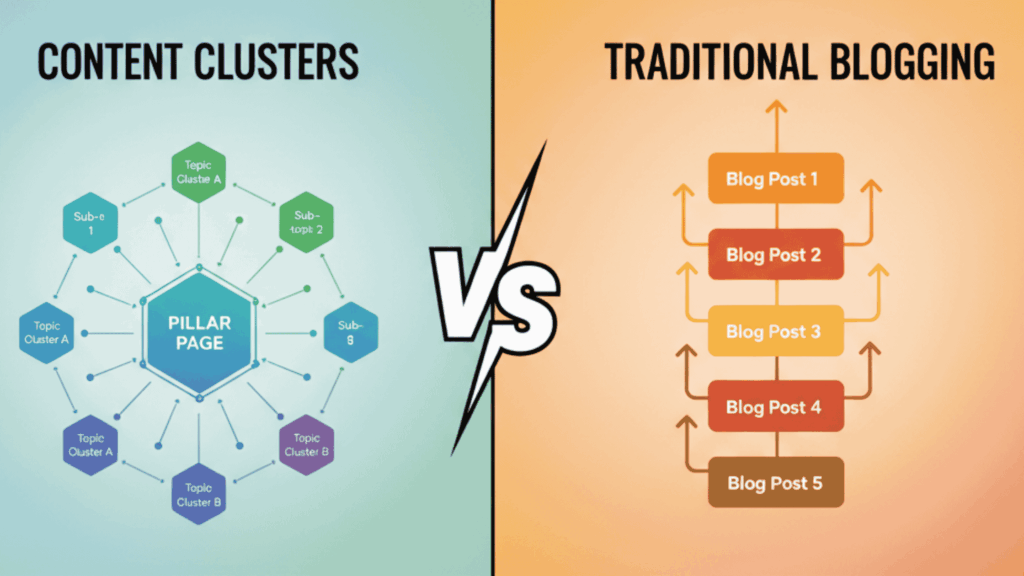
Traditional blogging is the approach most businesses have used since the early days of content marketing: write individual articles on a range of topics, publish them regularly, optimize each post for a specific target keyword, and build traffic piece by piece.
This model worked well when Google’s ranking signals were simpler. In the early 2010s, producing volume was enough. A business that blogged five times per week could outrank competitors that blogged twice a week, all else being equal.
The fundamental characteristics of traditional blogging include:
- Isolated articles that each stand alone with no deliberate internal linking structure
- Topics chosen based on individual keyword research rather than a broader strategic theme
- A focus on publishing frequency over content depth or interrelation
- Little to no consideration of how one post connects to or supports others on the site
The result is what SEO professionals call a siloed content structure — a website full of disconnected posts that compete against each other for authority rather than reinforcing it.
What Are Content Clusters?
The content cluster model (also called the pillar-cluster model or topic cluster strategy) was popularized by HubSpot around 2017 and has since become the benchmark for high-performance SEO content strategy.
Here’s how it works:
A pillar page is a long-form, comprehensive piece of content that covers a broad topic in depth. It’s designed to rank for a high-volume head keyword and serve as the authoritative hub for everything related to that topic on your website.
Cluster content (or cluster pages) are individual blog posts or articles that each cover a specific subtopic related to the pillar. Each cluster post targets a long-tail keyword within the broader topic, goes into focused depth on that subtopic, and links back to the pillar page.
This internal linking structure tells Google two important things: your site has comprehensive coverage of a topic, and your pillar page is the most authoritative resource for that topic. Both signals boost your search rankings.
Example of a Content Cluster:
- Pillar Page: The Complete Guide to Digital Marketing for Charlotte Businesses
- Cluster Posts:
- What is Local SEO and Why Does It Matter?
- How to Run Google Ads on a Small Business Budget
- Social Media Marketing Strategies for Charlotte Restaurants
- Email Marketing Best Practices for Local Service Businesses
- How to Choose a Web Design Agency in Charlotte
Each cluster post links back to the pillar, and the pillar links out to each cluster. This creates a tightly connected web of topical authority that signals deep expertise to Google’s crawlers.
Content Clusters vs. Traditional Blogging: A Direct Comparison
1. SEO Performance
Traditional blogging often results in keyword cannibalization — multiple posts competing for the same or similar keywords, splitting your authority and confusing Google about which page to rank. This is one of the most common reasons well-written content fails to rank.
Content clusters eliminate cannibalization by design. Each piece of content has a clearly defined purpose and keyword target. The pillar-cluster structure concentrates authority on the most important pages and uses cluster content to capture long-tail search traffic that individual posts could never reach on their own.
Winner: Content Clusters — by a wide margin.
2. User Experience
Traditional blogs are often difficult to navigate. A reader who lands on one post has no clear path to related content. They read, they leave. The average bounce rate for traditional blog posts is high precisely because there’s nowhere obvious to go next.
Content clusters create a natural content journey. A reader who arrives on a cluster post about Google Ads for small businesses will find a clear link to the broader pillar on digital marketing, where they’ll discover related content on SEO, social media, and more. Every cluster post reinforces the others, extending time on site and building brand authority with every additional page a reader visits.
Winner: Content Clusters
3. Content Production Efficiency
Here’s where traditional blogging appears to have an advantage on the surface: it’s simpler to execute. You pick a topic, write a post, publish it. There’s no need to think about how it connects to other content.
But this simplicity is a trap. Without a strategic structure, you end up producing a large volume of content that delivers a small fraction of the results it could. You’re essentially running in place.
Content clusters require more upfront planning — mapping your pillar pages, identifying cluster topics, and building the internal linking architecture. But once that structure is in place, every new piece of content you add strengthens the entire cluster. Your return per article compounds rather than staying flat.
Winner: Content Clusters (for long-term ROI)
4. Topical Authority
Google’s Helpful Content Update and its evolving E-E-A-T framework (Experience, Expertise, Authoritativeness, Trustworthiness) have made topical authority one of the most critical ranking factors in modern SEO.
Topical authority means Google sees your website as a trusted, comprehensive resource on a given subject — not just a site that has published a few posts mentioning a keyword. Building topical authority requires demonstrating depth and breadth of knowledge, which is precisely what the content cluster model is designed to do.
Traditional blogging that jumps between unrelated topics — a post about email marketing, then one about restaurant reviews, then one about home renovation tips — signals low topical coherence to Google. It’s the opposite of what the algorithm rewards.
Winner: Content Clusters — this is the defining difference in 2026.
5. Scalability
As your business grows, your content library should grow with it. Traditional blogging at scale creates a maintenance nightmare: hundreds of disconnected posts, many of which are outdated, some of which are cannibalizing each other, all difficult to organize and update systematically.
Content clusters scale beautifully. New cluster content is simply added to an existing topic cluster, strengthening it. Pillar pages can be updated periodically to reflect new information. The architecture gets stronger, not messier, as you publish more.
Winner: Content Clusters
When Does Traditional Blogging Still Have Value?
It would be unfair to say traditional blogging has zero value. For businesses just starting out with content marketing, a few foundational blog posts — even without a full cluster architecture — are better than nothing. They help establish your site’s voice, demonstrate expertise, and give Google something to index.
Additionally, timely content — news commentary, industry updates, event recaps — doesn’t always fit neatly into a cluster structure. These pieces can stand alone without hurting your overall strategy, as long as they aren’t meant to compete for core SEO keywords.
The key insight is this: traditional blogging and content clusters aren’t entirely mutually exclusive. The best content strategies use cluster architecture as the foundation and allow space for timely, standalone content alongside it.
How to Transition from Traditional Blogging to a Content Cluster Strategy
If you have an existing blog, don’t panic. You don’t need to start from scratch. Here’s a practical roadmap:
Step 1: Conduct a Content Audit
Inventory every post on your blog. Identify which topics you’ve covered, how each post is currently performing, and which posts are cannibalizing each other’s keyword rankings.
Step 2: Identify Your Core Topics
Choose three to five broad topics that align with your core services and audience interests. These will become your pillar page themes. For a Charlotte digital marketing agency, core topics might include SEO, paid advertising, social media marketing, website design, and email marketing.
Step 3: Build or Designate Your Pillar Pages
Either repurpose your strongest existing post on each topic as the pillar, or write a new comprehensive guide from scratch. Your pillar page should be your most thorough, authoritative resource on that topic — typically 2,500 words or more.
Step 4: Map Existing Posts to Clusters
Review your existing content and assign posts to the most relevant pillar. Update those posts with internal links pointing to the pillar page. This alone can produce meaningful SEO improvements within a few months.
Step 5: Plan New Cluster Content
Identify the long-tail keywords within each topic cluster that aren’t yet covered by existing content. Build an editorial calendar around filling those gaps systematically.
Step 6: Build the Internal Linking Architecture
Ensure every cluster post links to its pillar page. Ensure the pillar page links to every cluster post. Add contextual cross-links between related cluster posts where it makes sense for the reader.
This process is exactly what our team does for clients through our Content Creation services → and SEO services →, backed by deep keyword research and a thorough understanding of how Google evaluates topical authority today.
Why Charlotte Businesses Can’t Afford to Ignore This Shift
The Charlotte market is competitive and growing fast. Businesses in every industry — from home services to healthcare, legal to real estate — are investing in digital content marketing. The businesses that will win the next five years of organic search aren’t those publishing the most content; they’re those publishing the most strategically structured content.
A disorganized blog full of isolated posts is increasingly invisible to Google. A well-built content cluster strategy compounds in value every month as your topical authority grows, your internal linking deepens, and Google’s trust in your domain increases.
At Queen City Digital, we build content strategies that are rooted in data, structured for SEO performance, and designed to grow with your business. Whether you’re starting fresh or rebuilding an existing blog into a high-performance content cluster system, we’re ready to help. Contact our team today →
Frequently Asked Questions (FAQs)
Q1: How many content clusters should my website have?
Most businesses should start with three to five content clusters focused on their core service areas. Quality of structure matters far more than quantity. It’s better to build two strong, fully developed clusters than to spread thin across ten underdeveloped ones. As your content library grows, you can expand into additional clusters over time.
Q2: How long should a pillar page be?
A strong pillar page is typically between 2,500 and 5,000 words, though length should be driven by comprehensiveness, not a target word count. The goal is to cover your core topic thoroughly enough that a reader could get a complete overview without needing to look elsewhere. Your pillar should then direct readers to cluster posts for deeper dives on specific subtopics.
Q3: Will switching to content clusters hurt my existing SEO rankings?
Done carefully, transitioning to a content cluster model should improve your rankings over time, not hurt them. The key is to avoid deleting existing content prematurely. Instead, consolidate cannibalizing posts, update underperforming content, and build new internal linking structures. If significant restructuring is required, work with an experienced SEO agency to manage redirects and avoid losing existing link equity.
Q4: How long does it take for content clusters to show SEO results?
You can often see measurable improvements in organic traffic and keyword rankings within three to six months of implementing a content cluster strategy, particularly if you’re updating and interlinking existing content. Building a new cluster from scratch takes longer — typically six to twelve months — as Google needs time to crawl, index, and evaluate your growing topical authority.
Q5: Do content clusters work for local businesses?
Yes — and they’re particularly powerful for local SEO. A Charlotte-based business can build clusters around locally relevant topics (e.g., “Digital Marketing for Charlotte Restaurants” as a pillar, with cluster posts on local SEO, Google Business Profile optimization, and paid social ads for the Charlotte market). This builds both topical authority and local search relevance simultaneously.
Q6: What’s the difference between a pillar page and a landing page?
A pillar page is a content-driven resource page designed primarily to educate and to serve as the hub of a content cluster. It’s optimized for informational keywords and focuses on building topical authority. A landing page is a conversion-focused page designed to get visitors to take a specific action — book a call, sign up, make a purchase. They serve different purposes and should both exist in a well-rounded digital marketing strategy.
Q7: Can I implement a content cluster strategy without an agency?
Yes, but it requires significant time, expertise in SEO, keyword research, and content architecture. Many business owners find that the planning and execution required — especially the initial audit and pillar page creation — is better handled by an experienced team. Our Consulting & Strategy services → can help you build the roadmap even if you plan to handle some execution in-house.