


Forty-six percent of all Google searches have local intent, according to industry data on plumbing SEO. For plumbing companies, that makes proximity and response time central to the marketing calculation. Someone with a blocked drain, failed water heater, or burst pipe usually wants a qualified local professional who answers the phone and can arrive soon.
SEO for a plumbing company should therefore connect local visibility with service intent and booked-job measurement. Broad traffic may inflate reports without producing revenue. Prioritize the services that generate valuable work, then align the Google Business Profile, dedicated service pages, reviews, citations, and conversion tracking around those jobs. Emergency pages should make contact immediate, while high-ticket services need enough detail to support comparison and a considered booking decision.
Table of Contents
- Why Plumbing SEO Is a Local Game
- Optimizing Your Google Business Profile for Maximum Visibility
- Prioritizing Service Pages by Commercial Value
- Building Citations and Local Links That Matter
- Review Acquisition as a Ranking and Conversion Strategy
- Tracking ROI Beyond Vanity Rankings
- Your 90-Day Plumbing SEO Implementation Roadmap
Why Plumbing SEO Is a Local Game
Local search behavior is especially valuable for plumbers because the need behind the query is often immediate. A homeowner with a burst pipe, failed water heater, or backed-up sewer is usually choosing among providers who can answer the phone, serve the area, and arrive soon. That makes proximity and response time part of the marketing calculation, not just operational details.

A national ranking for “how to unclog a drain” may attract readers outside your service area. A prominent Maps listing for “emergency plumber near me” reaches someone selecting a provider in your operating area. The second query has fewer steps between discovery and contact, so Map Pack exposure can be more commercially useful than broad organic traffic.
Match the search to the job
SEO for a plumbing company should follow the work you want to sell. Plumbing searches typically fit three practical groups:
- Emergency searches: Burst pipes, overflowing toilets, sewer backups, and major leaks require clear availability, phone access, service areas, and response information.
- Planned repairs: Water heater repair, repiping, leak detection, and drain cleaning need useful service details, trust signals, and an obvious booking path.
- Installation and commercial work: Tankless systems, backflow testing, trenchless sewer repair, and commercial plumbing require technical authority, qualification content, and a stronger consultation path.
Give each commercially meaningful service its own page when the customer intent, process, proof, or conversion path differs. An emergency page should put the phone number and service area near the top. A replacement or installation page can spend more space on system options, preparation, warranties, and consultation requests. This prevents one generic plumbing page from competing for every query while giving high-value jobs enough room to support comparison.
Industry benchmarks report strong short-term action from local plumber searches and substantial demand for terms such as “plumber near me” and “emergency plumber.” Those figures appear in local SEO statistics for plumbers, but keyword estimates remain directional. They do not guarantee demand in your market, and they should not determine priorities without call, form, and booked-job data.
Your operating model should set the order of work. A 24-hour emergency crew may gain faster returns from Maps visibility, service-area clarity, and click-to-call paths. A company focused on replacement systems needs durable pages that explain complex purchases and qualify leads. For broader context, review this local SEO guide for small businesses in North Carolina.
Reviews affect whether a visible listing earns the call. A documented process to manage reviews for local SEO connects visibility with customer trust, while tracked calls and booked jobs show which services produce revenue.
Optimizing Your Google Business Profile for Maximum Visibility
Your Google Business Profile is the front door to local plumbing demand. Google primarily evaluates local results through relevance, distance, and prominence, as summarized in this explanation of Google Maps ranking factors. Relevance and prominence are shaped by your actions. You can improve profile relevance and build prominence through legitimate business signals, even if you cannot change your physical location.
Start with relevance
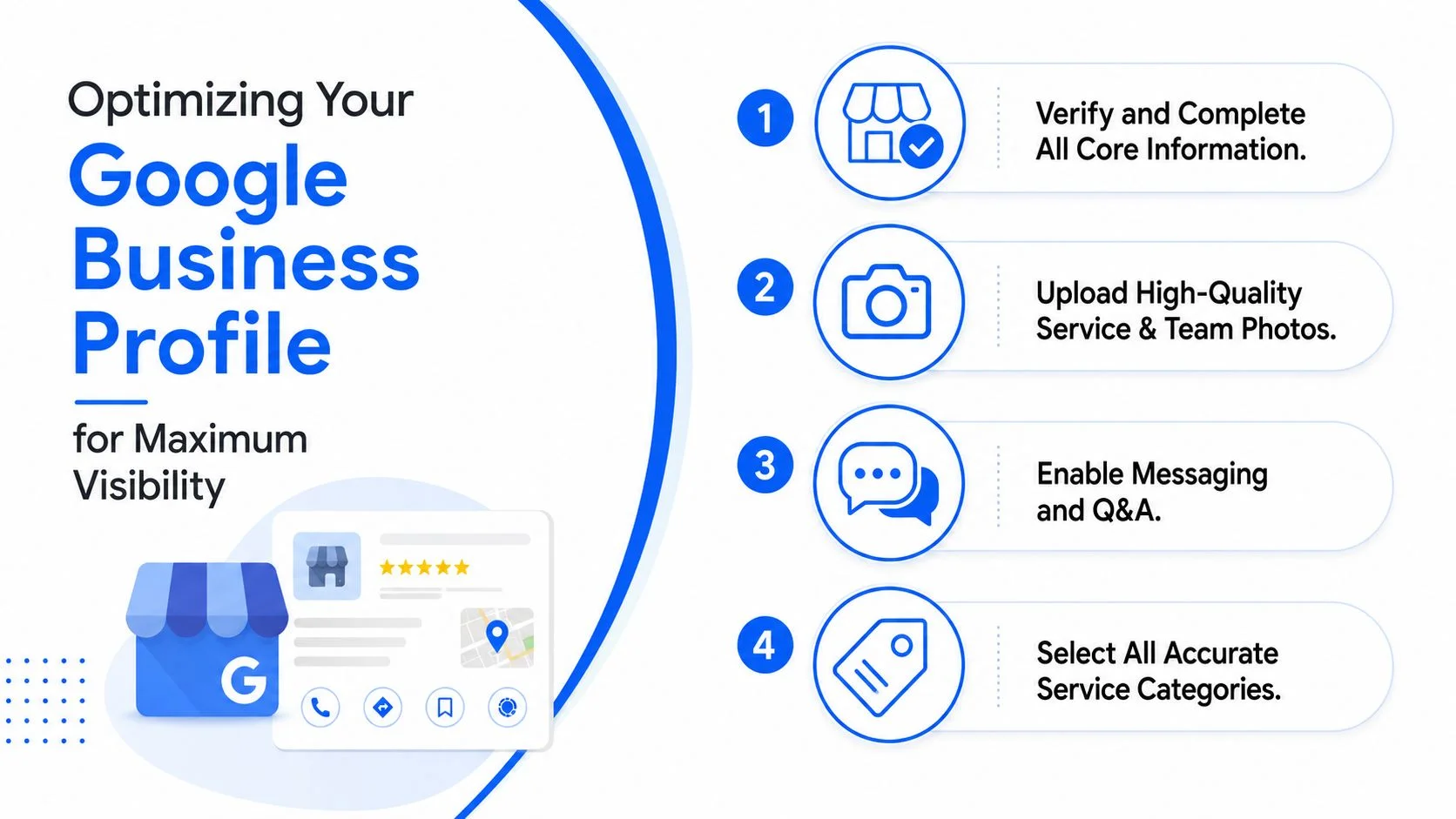
Choose the most accurate primary category. A plumbing contractor should make the main category reflect its core business, then add accurate secondary categories that apply. Unrelated categories can confuse users and weaken the profile’s relevance.
Complete every useful field:
- Business details: Keep the official name, phone number, website, hours, and holiday hours accurate.
- Service areas: List the communities your crews serve. Avoid claiming nearby cities that fall outside your normal travel range.
- Services: Add distinct services with plain-language descriptions that match the website and the jobs you want.
- Photos: Upload current images of trucks, technicians, equipment, completed work, and the team.
- Messaging and questions: Enable available communication features and monitor them during business hours.
- Updates: Publish useful posts about seasonal services, maintenance, and availability without stuffing keywords.
The website and profile should reinforce each other. If the profile highlights water heater repair while the website lacks a substantive page for that service, relevance weakens and prospects have less information before calling.
Build prominence carefully
Prominence reflects the company’s broader footprint. Accurate citations, genuine reviews, locally relevant mentions, and consistent business information support credibility. Duplicate profiles, old phone numbers, mismatched names, and outdated hours create avoidable friction.
Track calls, website clicks, and direction requests in the profile reporting environment. A ranking position is only useful if people can find the listing, trust it, and take action. Compare those actions with call records and completed-job data. This shows whether the profile is generating emergency calls, scheduled work, or high-value opportunities, rather than just occupying a visible position.
For a market-specific walkthrough, review this guide on how to rank on Google Maps in Charlotte. The same principles apply elsewhere, while service areas, competitors, and customer expectations vary by market.
Prioritizing Service Pages by Commercial Value
A page for every service in every city can leave a plumbing site with thin, near-identical URLs. “Drain cleaning in” pages that offer no distinct local information rarely give searchers a reason to choose them. A dedicated page deserves investment when the service has meaningful commercial value, identifiable search demand, and a realistic chance of local visibility.
Keyword datasets identify demand around drain cleaning, water heater repair, sewer repair, backflow testing, tankless installation, hydro jetting, slab leak repair, and trenchless sewer repair, as discussed in this plumbing keyword prioritization analysis. Treat that list as a starting point. Compare each service with your margins, technician capabilities, service area, competition, and lead quality before assigning it a page.
Use a decision matrix
| Service Type | Commercial Value | Search Intent | Page Strategy |
|---|---|---|---|
| Emergency repair | High when response speed matters | Immediate call | Dedicated page with prominent phone CTA, service-area clarity, availability, safety guidance, and trust signals |
| Routine maintenance | Variable | Research or scheduled service | Bundle related tasks when the customer journey is similar, then link to focused sections |
| Water heater repair | Often strong | Repair or replacement evaluation | Dedicated page covering symptoms, repair options, replacement decisions, and qualification questions |
| Tankless installation | High-ticket planned work | Technical and commercial | Dedicated authority page with system fit, installation process, maintenance, and consultation CTA |
| Sewer repair | High-value and problem-driven | Diagnosis and urgent action | Dedicated page with inspection, repair methods, property considerations, and financing or scheduling information |
| Regulated commercial service | Specialized | Compliance and vendor selection | Dedicated page with credentials, documentation, service coverage, and commercial contact path |
Emergency pages must answer, “Can you help me now?” Put service availability, phone access, response expectations, financing details where applicable, and local proof near the top. A long introduction should not push the call option below the first screen.
Planned installation pages need a different structure. Explain the decision and the installation process, so visitors understand what they are committing to. Cover system fit, property requirements, maintenance, project steps, and what happens after form submission. This qualifies leads and reduces calls from visitors who are not ready to proceed.
Practical rule: Build the page around the customer’s decision, then place the keyword where it naturally identifies the service.
Create a keyword map that assigns one primary intent to each important URL. Guidance on keyword placement for SEO can help align titles, headings, body copy, image descriptions, and internal links without repetitive phrasing.
A service page should earn its existence by being materially different. Before creating a city variation, confirm that you can add genuine local information, such as service boundaries, property types, common infrastructure, regulations, or completed work relevant to that area. If you cannot, strengthen the main service page and build useful internal links instead.
Measure commercial value through calls, qualified form submissions, booked jobs, average job value, and close rate by service page. Rankings show visibility, but those actions show whether the URL supports profitable work. A content cluster strategy can connect diagnostic articles and maintenance guidance to the service pages that generate calls.
Building Citations and Local Links That Matter
Citation building is about making the same business information easy to verify across reputable platforms, not about submitting a company to every directory that accepts a listing. For plumbing companies, accurate profiles support both emergency searches and higher-value service decisions, while relevant local links can send qualified prospects directly to the site.
Start with an audit. Record the business name, address or service-area setup, phone number, website, hours, categories, and profile status for each listing. Check for duplicate profiles, outdated branding, disconnected tracking numbers, and service descriptions that no longer match the company. Fixing these issues first is faster than creating more listings on top of unreliable information.

Prioritize useful sources
Use this order:
- Core platforms: Verify the major search and mapping profiles first, especially the profiles customers use during urgent service searches.
- General business directories: Maintain accurate listings on established platforms used by customers and local businesses.
- Trade directories: Consider credible plumbing, contractor, and home-service associations with editorial standards.
- Supplier and partner pages: Ask manufacturers, wholesalers, builders, and property-service partners whether they maintain vendor directories.
- Community organizations: Local chambers, neighborhood groups, charities, and event organizers can provide relevant mentions when the relationship is genuine.
Avoid bulk packages promising hundreds of directory links. A smaller set of accurate, trusted references is more useful than duplicated listings on irrelevant or low-quality pages. Review results by referral visits, calls, and qualified inquiries, not by listing count.
Earn links through real relationships
Local outreach works best when it offers something useful. A plumbing company could provide a seasonal maintenance checklist to a property manager, contribute technical guidance to a home-improvement publication, or support a community project that publishes sponsor information.
Keep the request direct:
“We serve homeowners and property managers in this area. We’ve prepared a practical guide to preventing common plumbing failures. If it helps your audience, you’re welcome to reference it.”
Do not demand exact-match anchor text or buy placement on unrelated sites. A relevant link may introduce the company to a customer, while an artificial link adds risk without supporting local demand.
Keep core business details consistent, but let service descriptions read naturally on each platform. For broader online presence and reputation management, connect citation cleanup with review monitoring and customer response processes.
Review Acquisition as a Ranking and Conversion Strategy
A plumbing review system has two jobs. It helps strengthen local prominence, and it gives a nervous customer evidence that the company handles the exact problem they’re facing.
An independent local-search analysis found that review signals become more influential among higher-ranking Maps listings. Across the top 21 Google Maps positions, the analysis reported proximity at about 55.2% and review count at about 19.2%. Within the top 10, proximity fell to 36.2%, while review count rose to 26% and review keyword relevance reached 22.8%, according to this analysis of Google Business Profile ranking signals. The practical takeaway is not to chase a specific threshold. It’s to build a steady, policy-compliant stream of authentic customer feedback.

Make requests part of delivery
Ask after a clear service milestone, such as a completed repair, a confirmed installation, or a resolved callback. The request should come from a real interaction, identify the business correctly, and make the next step easy. Email and text can both work when customers have consented to those communications.
Don’t offer rewards for positive reviews, pressure customers to change feedback, or filter requests so only happy customers receive them. Those shortcuts can damage trust and violate platform rules.
Review responses should be timely and specific without exposing private customer information. Thank the customer, acknowledge the service category when appropriate, and move unresolved issues to a private channel. A calm response to criticism can reassure prospects who are comparing providers.
Use customer language
Review text can reveal how customers describe the company’s services. If people repeatedly mention “same-day water heater repair,” “sewer camera inspection,” or a particular suburb, that language can inform page headings, FAQs, service descriptions, and ad copy. Don’t copy reviews into pages as keyword filler. Use recurring themes to make the site sound more like the market it serves.
Create a direct review link and document the internal process in a guide such as how to generate a Google review link. Assign responsibility to the office team, establish a response owner, and review feedback for operational problems as well as marketing insights.
Tracking ROI Beyond Vanity Rankings
Rankings are diagnostic signals, not business outcomes. A plumber can hold a strong position for a low-value informational phrase and still miss calls from emergency searches. The reporting system should connect visibility, contact actions, qualified leads, booked work, and revenue.
Start with a baseline before major changes. Record organic calls, website forms, Google Business Profile actions, direction requests, service categories, call outcomes, and closed-job status. Keep branded and non-branded activity separate where your tools allow it. That distinction shows whether SEO is expanding discovery or merely capturing people who already know the company.
Build the measurement path
Use Google Search Console to review queries, impressions, clicks, and landing pages. Use Google Analytics or another analytics platform to track form submissions, click-to-call actions, and important engagement events. Call tracking can identify the source and landing page associated with a phone inquiry, but use it carefully so the primary business number remains consistent across important listings.
A useful weekly dashboard can include:
- Demand: Search impressions and clicks for priority service and location themes.
- Local actions: Profile calls, website visits, and direction requests.
- Lead quality: Emergency versus planned inquiries, service type, location, and qualification status.
- Sales outcome: Booked jobs, completed jobs, and canceled or unqualified leads.
- Efficiency: Organic acquisition cost by service line, compared with paid and referral channels.
- Page performance: Calls and forms generated by each priority service URL.
Don’t assign every conversion to the last click and call the analysis complete. A customer may discover the company through Maps, return through an organic service page, and call from a branded search. Use consistent source capture in the CRM and ask callers how they found the company.
SEO and paid search can work together, but they serve different planning needs. Paid campaigns can provide immediate control while organic assets develop. Search-query data from paid campaigns can also help validate which services deserve stronger organic pages, provided the business measures lead quality rather than clicks alone.
Your 90-Day Plumbing SEO Implementation Roadmap
A workable roadmap starts with the assets closest to revenue. Don’t publish a large content library while the profile is incomplete, the phone number is hard to find, or the office has no process for recording booked jobs.
Days 1 through 30 build the foundation
Verify and complete the Google Business Profile. Confirm the primary category, service areas, hours, services, photos, website link, and contact paths. Audit citations and remove obvious inconsistencies or duplicates.
At the same time, review the website’s structure and select the first service pages using commercial value, customer intent, and local feasibility. Improve the homepage and priority pages with clear service descriptions, local coverage, trust evidence, click-to-call buttons, and forms that work well on mobile devices.
Success check: The company information is accurate, priority URLs are assigned, tracking events are documented, and every lead can be connected to a service category.
Days 31 through 60 create momentum
Launch the review request workflow after completed work. Train dispatchers, technicians, and office staff on when to request feedback and who responds to it. Expand the highest-priority service pages with original answers, process details, qualification information, and internal links from relevant educational content.
Begin local outreach with suppliers, trade organizations, property managers, community groups, and complementary contractors. Pursue relationships that can produce both referral opportunities and legitimate local mentions.
Success check: Review requests are being sent consistently, responses have an owner, and priority pages receive relevant internal and external support.
Days 61 through 90 improve decisions
Connect profile actions, website conversions, phone records, and CRM outcomes. Compare emergency, repair, installation, and commercial leads separately. Use Search Console queries and sales-team feedback to identify missing services, confusing language, and pages that attract the wrong visitors.
Then analyze competitor gaps manually. Compare their service coverage, review themes, page depth, local proof, response experience, and calls to action. Don’t copy their wording. Find the useful information they fail to provide and make that the next content or conversion improvement.
A small team can complete this in focused batches, while an agency can manage production, tracking, and optimization together. Queen City Digital offers local SEO, Google Maps work, conversion-focused website development, reputation management, and analytics configuration for service businesses, including plumbing companies in the Charlotte and Carolinas market.
Queen City Digital can help your plumbing company prioritize revenue-producing service pages, improve Google Business Profile visibility, and connect SEO activity to calls and booked jobs. Visit Queen City Digital to discuss a practical local growth plan built around your service area and commercial priorities.


