The most repeated advice about local SEO citations is also the least useful: build as many listings as possible, then keep adding more. That playbook made sense when citation quantity was treated as a major local ranking signal. In 2025 and 2026, the practical question is different. Does another low-value directory listing help search engines trust your business, or does it just create another record that someone must maintain?
A citation profile should support entity validation, accurate business information, and customer trust. Core platforms, industry directories, mapping services, and credible local mentions usually deserve attention before obscure directories. The work is less glamorous than bulk submission, but it’s more defensible, especially for service-area businesses and companies with multiple locations.
Table of Contents
- Why Citation Volume Isn’t the Whole Story
- What Local SEO Citations Actually Are
- Why Citations Matter for Local Search Rankings
- How to Audit Your Existing Citations
- Building New Citations the Right Way
- Citations in the Age of AI Search
- Real-World Citation Success Stories
Why Citation Volume Isn’t the Whole Story
The old “build 100 citations” recommendation treats every directory as if it carries the same authority. It doesn’t. A correct listing on Google Business Profile, Apple Maps, Bing Places, Yelp, or a relevant trade directory has a clear purpose. A forgotten listing on an unvisited directory can add little value while creating another opportunity for a wrong phone number, outdated address, or duplicate business record.
A foundational BrightLocal citations study provides useful historical context. It found that the average local business had 81 citations, while the median was 108, showing that citation profiles were already widely distributed rather than organized around one universal target. Businesses ranking first on Google Local averaged 86 citations, while businesses in position ten averaged 75, an 11-citation gap. That relationship is informative, but it doesn’t prove that creating eleven more listings would move a business from tenth place to first.
Citation hygiene versus citation spam
The distinction matters:
- Citation hygiene means correcting the business name, address, phone number, categories, hours, and duplicates on important platforms.
- Citation expansion means adding carefully selected listings that customers, search engines, or industry reviewers might reasonably use.
- Citation spam means submitting the same business to large numbers of weak directories without checking authority, relevance, indexing, or maintenance requirements.
Google’s local results rely on more than citations. Relevance, distance, prominence, reviews, the Google Business Profile, website signals, and the overall credibility of the business all contribute to visibility. Citations support that system by helping platforms reconcile the same company across different records. They’re a foundation, not a substitute for a useful website, strong reviews, or a well-maintained profile.
Practical rule: Fix a high-authority listing with incorrect information before creating a low-authority listing with correct information.
Service-area businesses need an even more disciplined approach. A plumber, roofer, or HVAC contractor may serve multiple communities without displaying a customer-facing address. Publishing inconsistent addresses across directories can create confusion rather than expand reach. A better strategy combines accurate core listings with service-area pages, relevant trade references, local relationships, and a reputation process. Businesses that want a broader framework for managing trust across channels can also review this guide to building a strong online presence and reputation.
BrightLocal’s later expert research reinforces the shift in emphasis. In 2015, 55% of local SEO experts called accurate citations “critical” to local ranking, 71% said quality mattered more than quantity, and 57% considered merging or deleting duplicates very important, as reported in BrightLocal’s citation survey coverage. By 2018, 90% still said accurate citations were important to local ranking. The lesson isn’t that citations stopped mattering. It’s that accurate, trusted coverage matters more than a large spreadsheet of questionable submissions.
What Local SEO Citations Actually Are
A local SEO citation is a mention of a business’s identifying information on another platform. The classic format includes name, address, and phone number, often called NAP. Modern citations can also include a website, business category, hours, service areas, booking link, photos, reviews, and descriptions.
A structured citation appears in a defined business listing. Yelp, Yellow Pages, Facebook, Google Maps, Apple Maps, and Bing Places all use structured fields. The platform expects a business name in one field, an address in another, and a phone number in another. That structure makes the information easier for platforms to process and compare.
An unstructured citation looks different. A local newspaper might mention a roofing company in an article about storm preparation. A neighborhood association might list a sponsor on its website. A chamber of commerce, supplier, event page, or trade publication might refer to the business without presenting a standard directory profile. The information may still help establish that the company operates in a real market and serves a real community.

How search platforms use citation information
Search systems try to connect records that refer to the same entity. Consider a business listed as “Carolina Comfort HVAC” on one platform, “Carolina Comfort Heating and Air” on another, and “Carolina Comfort HVAC LLC” elsewhere. Those names may describe one company, but inconsistent addresses, phone numbers, or categories make reconciliation harder.
A good structured citation gives the platform another dependable reference point. A poor citation adds ambiguity. That’s why the practical value of a listing depends on accuracy, authority, relevance, and consistency, not merely whether the URL exists.
Citations also appear across different search surfaces. Maps need reliable location and contact information. Voice assistants need clear business records. AI answer engines may draw from a wider collection of directories, websites, reviews, community discussions, and structured data. Businesses preparing to improve local SEO rankings should therefore think beyond directory count and build consistent signals across the platforms their customers use.
What good and bad citations look like
A good citation uses the actual business name, the correct public address or service-area configuration, a primary phone number, an accurate category, and a working website. It matches the company’s official information without stuffing keywords into the name field.
A bad citation might use an old office address, a tracking number that differs from the main contact number, an unapproved keyword-rich business name, or a duplicate profile created after a move. For a deeper local foundation, pair citation work with a practical guide to local SEO for small businesses in North Carolina.
Why Citations Matter for Local Search Rankings
Citations help search systems determine whether separate online records describe the same business. Their value comes from reducing uncertainty, not from increasing a listing count by itself. A business can publish dozens of profiles and still perform poorly if its Google Business Profile is incomplete, its website lacks useful local information, its reviews are weak, or its service area conflicts with the searcher’s location.
As noted earlier, the citation gap between top and tenth-place businesses shows correlation, not causation. The practical question is therefore not how many listings a company can create, but whether its core ecosystem presents one clear, trustworthy business record. Strong citations reinforce other local signals, including prominence, website authority, reviews, proximity, category relevance, and customer engagement.
NAP consistency as a data-quality filter
Consistent name, address, and phone details help platforms match records to one entity. A mismatch on a low-value directory may have limited impact, while conflicting information across important map services, data providers, or industry sources can create lasting confusion.
Common problems include:
- A suite number appears on the website but disappears from major directories.
- A call-tracking number replaces the primary phone on selected listings.
- A rebrand leaves the former business name active on third-party platforms.
- A move creates two profiles, one current and one abandoned.
- A franchise location inherits details from the parent company.
These conflicts can generate duplicate entities, route customers to the wrong location, or reduce confidence in the business record. The workable process is simple: define one approved format, check the highest-impact sources first, and apply the same details wherever the business is represented. The five-step guide to auditing local business citations provides a practical reference for that review.
What the survey evidence means for practitioners
Citation accuracy remains a baseline expectation among local SEO practitioners. BrightLocal’s expert survey found that 90% of local SEO experts considered accurate citations important to local ranking, according to BrightLocal’s expert local citation survey. That finding supports maintaining reliable records. It does not support paying for bulk packages that promise hundreds of low-value listings.
The strongest return often comes from removing ambiguity. Correcting a primary phone number, merging duplicate profiles, or fixing an address on a major map platform can improve customer access and help search systems identify the business. Ranking changes may still involve several factors, but these fixes produce clear operational improvements.
For map-focused businesses, citation accuracy should support profile completeness, review management, category selection, website relevance, and location signals. The guide to ranking on Google Maps in Charlotte shows how citation work fits within that wider system, rather than treating listings as an isolated ranking tactic.
How to Audit Your Existing Citations
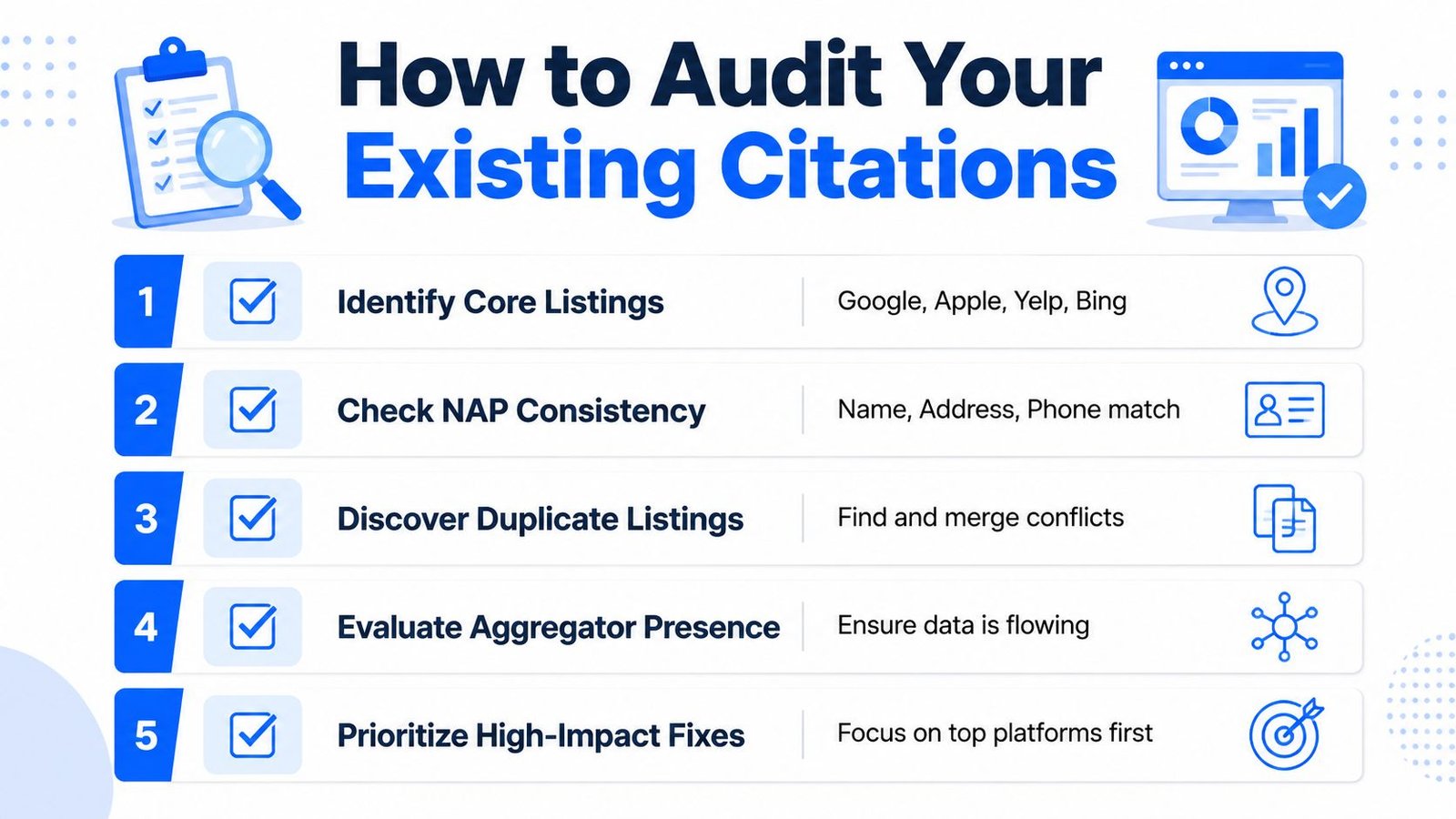
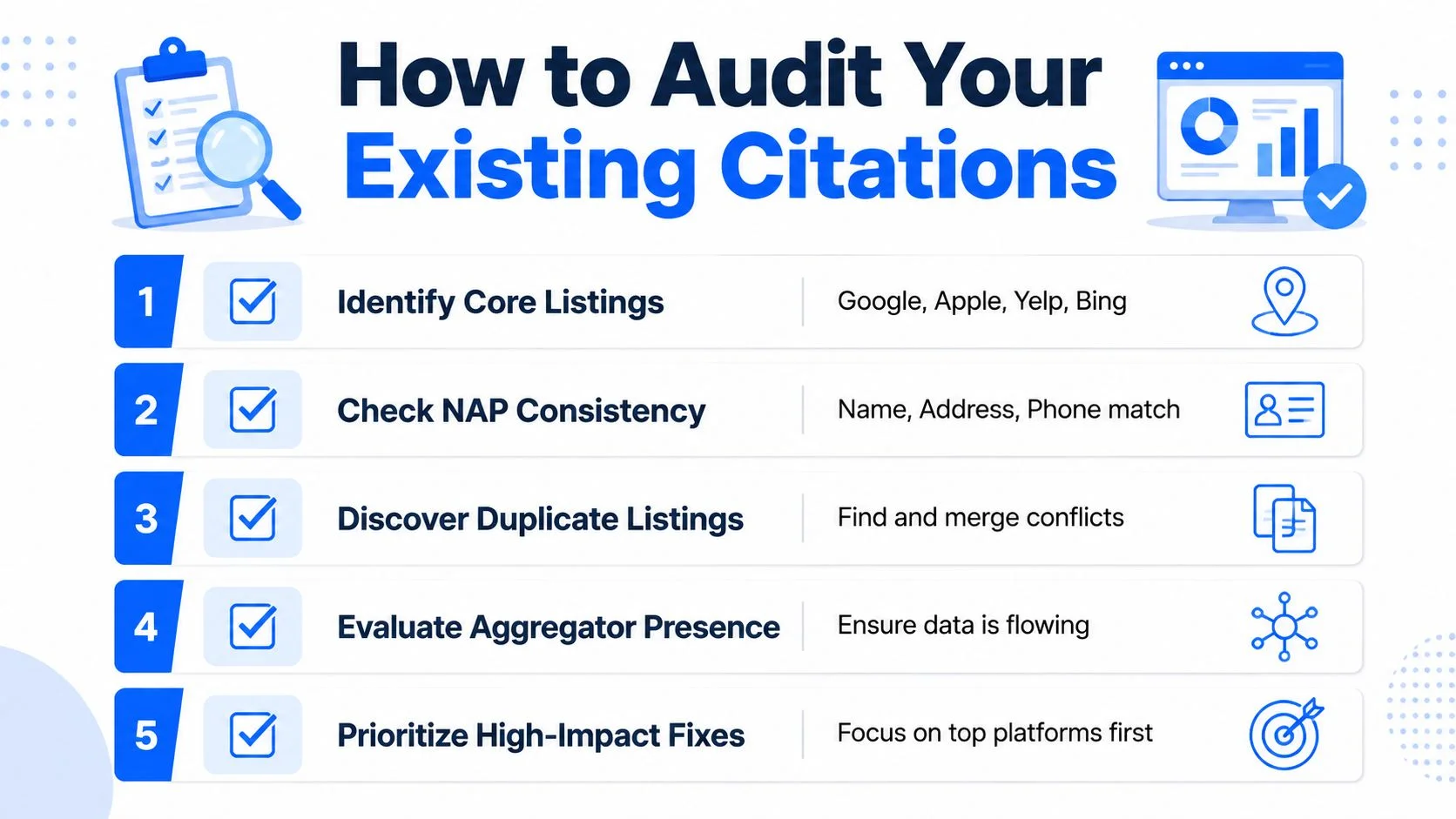
Start with a baseline before changing anything. Create a spreadsheet with the business name, address, phone, website, categories, hours, listing status, duplicate status, login owner, and the date checked. Record the live URL and capture notes about incorrect information. Without a baseline, teams often fix one listing and lose track of what remains unresolved.
Begin with the core ecosystem
Check the platforms customers and search engines are most likely to encounter first:
- Google Business Profile: Confirm the verified profile, primary category, service area, phone, website, hours, and duplicate listings.
- Apple Maps: Review the business record used by Apple devices and navigation surfaces.
- Bing Places: Check whether the listing is claimed and whether its data matches the approved record.
- Yelp and Facebook: Verify public contact details, categories, hours, and links.
- Industry and regional sources: Review trade associations, chambers, licensing references, and respected local directories.
A restaurant owner may need a different audit emphasis from a roofing contractor. Restaurant operators should pay close attention to menus, reservation links, holiday hours, and location details. A practical GBP audit for restaurant owners can supplement the broader citation review.
Find conflicts and duplicates
Search the business name in quotation marks, then search combinations of the business name and phone number, business name and address, and old phone numbers or addresses. Search each major directory directly as well. Old branding often reveals records that a general search misses.
Classify every issue before taking action:
- Update: Use this for a legitimate listing with incorrect details.
- Merge: Use this when two records represent the same real-world location and the platform offers a supported process.
- Remove or suppress: Use this for an ineligible, fraudulent, or permanently closed listing, following platform policy.
- Leave unchanged: Use this when a minor display difference reflects platform formatting rather than a real data conflict.
Prioritize the fixes
Don’t spend an afternoon correcting an obscure directory while a major map listing shows the wrong phone number. Fix verified profiles, map platforms, prominent consumer directories, data sources, and industry-specific records first. Then monitor whether corrected information propagates or whether another source recreates the conflict.
Review generation should also connect to the audit. A clean profile that never receives customer feedback won’t build the same trust as one supported by an active reputation process, so businesses can use a consistent Google review link workflow after service completion.

Building New Citations the Right Way
New citations make sense after the core profile is accurate. Expansion should follow customer behavior and business relevance, not an arbitrary quantity target. A medical practice may prioritize health directories, local hospital affiliations, professional associations, and insurance references. A contractor may benefit more from trade organizations, supplier profiles, licensing bodies, and credible regional resources than from generic directories.
Use one approved NAP format, but don’t copy every description word for word. Keep the official business name unchanged, select the most accurate primary category, describe actual services, and link to the most relevant page. Service-area businesses should explain where they work without publishing an address that customers can’t visit.
Manual work versus managed tools
| Approach | Cost Range | Time Investment | Accuracy Control | Best For |
|---|---|---|---|---|
| Manual submissions | Variable | High | Highest when carefully managed | Small profiles with a limited, high-priority list |
| Citation software | Variable | Moderate | Depends on source coverage and review | Teams managing multiple locations or recurring checks |
| Managed citation service | Variable | Low internal time | Depends on provider process and reporting | Operators without staff for research, submissions, and cleanup |
| Authority-led outreach | Variable | Moderate to high | High, because each mention is reviewed | Businesses pursuing local press, community, and industry relevance |
The trade-off is control versus efficiency. Manual work lets you inspect every field and avoid unwanted changes, but it consumes staff time and requires follow-up. Software can identify inconsistencies and reduce repetitive work, yet automated updates may not handle unusual business models, service-area rules, rebrands, or duplicate records gracefully. Managed services reduce execution burden, but the business owner still needs to approve the canonical information and retain access to important accounts.
Measure usefulness, not submission count
Track the listing URL, date created or corrected, platform type, business information, and whether the platform is indexed or visible to customers. Watch branded search results, map discovery, direction requests, calls, form submissions, and customer comments about finding the business. Don’t assign every movement to one new citation. Local visibility changes as the entire profile, website, review, and competitive environment changes.
Unstructured mentions deserve a place in the plan too. A credible local article, sponsorship page, neighborhood organization, or professional publication may provide more contextual trust than another generic directory. Businesses exploring how to boost brand mentions with citations should still ask whether each opportunity is relevant, genuine, and maintainable.
Citations in the Age of AI Search
Customers no longer discover local businesses through one interface. They may use Google Maps, Apple Maps, a voice assistant, a traditional search result, a review platform, or an AI-generated answer. Each surface may draw from different records, which makes consistency more valuable than a long list of disconnected submissions.
AI search also broadens the meaning of a citation. A business can be mentioned in a local publication, community forum, event page, supplier directory, professional association, or customer discussion without appearing in a conventional NAP directory. These references provide context about what the company does, where it operates, and whether other organizations recognize it.

Match the citation to the search surface
For map searches, prioritize Google Business Profile, Apple Maps, Bing Places, Yelp, and accurate location data. For conversational searches, make the website’s services, locations, credentials, hours, and contact information easy to interpret. For recommendation-oriented queries, reviews, independent mentions, industry references, and clear service pages provide context that a bare directory entry can’t supply.
Schema markup can complement citations by clarifying the organization, location, service, phone, website, and relationships between entities. It won’t repair an incorrect directory listing, but it gives search engines another structured reference point. The same principle applies to on-page information. If the site describes one location while third-party profiles describe another, structured data won’t solve the contradiction.
Build coverage around trust
The forward-looking strategy is selective:
- Maintain accurate core map and directory entities.
- Align website contact details, location pages, and schema.
- Earn genuine mentions from local organizations and relevant publications.
- Keep categories and services consistent with the actual business.
- Monitor AI answers, map profiles, and branded search results for incorrect information.
Businesses preparing their websites for generative discovery can pair citation work with AI search optimization for generative engines. The objective isn’t to manufacture mentions. It’s to make the business easy to identify and accurately describe across a fragmented ecosystem.
Real-World Citation Success Stories
Citation problems rarely announce themselves as ranking problems. They show up as a customer calling an old number, a map user driving to a former office, or a review appearing on the wrong profile. The following scenarios are representative operating situations, not quantified case studies, so the lesson is the workflow rather than an invented performance claim.
The contractor with competing profiles
A home service contractor found two map listings using nearly identical names. One contained the current phone number, while the other held older reviews and outdated service information. Customers encountered conflicting hours, and the business appeared fragmented across search surfaces.
The audit began by identifying which profile represented the legitimate location, documenting ownership, and comparing the address, phone, website, categories, and reviews. The duplicate was handled through the platform’s supported merge or removal process, while the surviving profile received the approved information. The team then checked important directories for the old phone number and previous business name.
The improvement was operational before it was algorithmic. Customers had one profile to trust, the review history no longer pointed in competing directions, and staff stopped answering calls routed through an obsolete record.
The medical practice with a phone-number conflict
A medical practice used its main office number on the website but a call-tracking number on several directory listings. The tracking setup had been introduced for marketing measurement, yet patients reached inconsistent destinations depending on which result they selected.
The practice chose one primary public number for core citations and kept campaign attribution in controlled channels rather than rewriting foundational listings indiscriminately. Staff verified the number on maps, healthcare directories, social profiles, local references, and appointment pages. The website and profile links were tested from a patient’s perspective, not just checked for matching text.
The key lesson is that measurement should not compromise entity clarity. Tracking is useful, but it needs a clear implementation plan that preserves the business’s primary identity across trusted sources.
The professional firm that stopped chasing generic directories
A professional services firm had accumulated many low-value listings but lacked strong references from organizations connected to its actual work. Its audit found thin profiles, inconsistent practice descriptions, and little evidence of local involvement.
The firm reduced its focus on broad submissions and pursued accurate profiles with relevant professional associations, regional business groups, and legitimate community relationships. Its website clarified services and locations, while the citation spreadsheet documented ownership and approved formatting. The result was a more coherent reputation footprint, even without treating directory count as the main success metric.
The common thread is prioritization. Citation work performs best when it removes confusion, strengthens authoritative references, and supports the wider local search system. It’s maintenance, trust building, and data governance, not a shortcut around the fundamentals.
Queen City Digital audits and cleans up local SEO citations, aligns Google Business Profile and website signals, and builds lead-generation systems for service businesses across Charlotte and the Carolinas. Visit Queen City Digital to request a practical local visibility assessment focused on the listings, reputation signals, and conversion paths that matter most.