


A plumber in a mid-sized town is staring at a quote for an $1,800 water-heater replacement that came from a Meta lead form ad she launched last Tuesday. She used to depend on word of mouth and her Google Business listing. Now, paid social is helping fill the gaps between referrals, search calls, and slower weeks, even when she manages campaigns between school pickups.
That decision is becoming normal for small and regional businesses. Worldwide social media ad spend reached $234.14 billion by 2025, according to Statista’s social media marketing data. The channel has moved from experimental branding support to a serious acquisition system, but the practical challenges are still easy to underestimate.
The two problems that matter most are proving whether paid social created new demand and producing enough creative to keep campaigns useful without hiring a production studio. The sections below address both, with a focus on booked appointments, qualified leads, and revenue rather than attractive dashboard screenshots.
Table of Contents
- Why Local Businesses Are Spending on Paid Social Now
- What Paid Social Media Advertising Actually Is
- Choosing the Right Channel for Your Business
- Ad Formats Matched to Funnel Stages
- Building Audiences That Convert
- Creative That Stops the Scroll for Service Businesses
- Measuring What Matters Beyond ROAS Screenshots
- Budget Strategy and a Practical Launch Checklist
Why Local Businesses Are Spending on Paid Social Now
Paid social’s growth has a clear historical starting point. Facebook launched self-serve ads in November 2007, pairing Facebook Ads with Social Ads that used signals such as a user’s likes inside ad units, as documented in this history of Facebook Ads. That shift made demographic targeting accessible to ordinary advertisers and helped social networks develop into performance platforms.
The market expanded quickly after that. Industry reporting based on Statista data records social media ad spending at $51.3 billion in 2017, $97.5 billion in 2019, $132.8 billion in 2020, $180.9 billion in 2021, and $207.1 billion in 2023. Those figures show why local operators now encounter a far more competitive auction than the one available when social advertising was mostly a branding experiment. The latest Statista topic data places worldwide spend at $234.14 billion by 2025.
The local discovery shift
A homeowner may still search Google for an emergency plumber, but discovery happens in other ways too. Someone sees a short video explaining a clogged drain, notices a neighbor’s recommendation in a local community, or watches a med-spa testimonial before ever typing a service into a search bar.
That creates room for businesses that can demonstrate expertise before a buyer has formed a precise query. Home services, dental practices, med-spas, legal offices, local retailers, and regional B2B companies can use paid social to introduce a problem, show proof, and invite the next step.
For operators building their first system, these small-business social media marketing tips for North Carolina are a useful complement to paid campaigns. Organic content still supplies credibility, but paid distribution gives a specific offer a controlled path to a defined local audience.
Operator’s view: Paid social can become a primary acquisition channel, but only when the business tracks what happens after the form submission.
The opportunity isn’t more impressions. It’s a faster way to test offers, messages, and proof assets in the neighborhoods or professional audiences the business serves. The discipline is spending enough to learn while refusing to confuse platform activity with profitable demand.
What Paid Social Media Advertising Actually Is
Paid social media advertising means paying a social platform to place a business message in front of selected users. The placement may appear in a Facebook Feed, Instagram Story, Instagram Reel, TikTok feed, LinkedIn feed, inbox, or another available environment. The advertiser chooses an objective, audience, creative format, conversion event, and budget, while the platform’s auction decides where and when the ad appears.
The simplest analogy is a sponsored seat at a dinner table. A billboard interrupts everyone driving along a highway, while a social ad enters a feed where people have already chosen to spend attention. The setting provides context, but the advertiser still has to earn interest quickly.
Three channels people confuse
Organic posting is the unpaid activity on a business profile. It supports familiarity, proof, and community, but distribution depends on platform behavior and audience engagement. A good organic post can help a paid ad feel credible, yet an organic post isn’t a substitute for controlled reach.
Search advertising is different because it responds to expressed intent. A Google Search ad can meet someone actively looking for “water heater repair near me,” while a Meta ad may introduce the problem to someone who hasn’t searched yet. Display advertising generally works through visual placements across websites and apps, rather than blending primarily into a social feed.
Influencer collaborations occupy another category. The creator may publish a sponsored video to an existing audience, but the transaction is often arranged as a sponsorship. A brand can sometimes amplify that content through a platform ad account, which combines creator trust with paid distribution, but the original partnership and the media buy remain distinct decisions.
What the channel can’t repair
Paid social can place a specific service offer before a geographically defined audience quickly. It can generate inquiries, collect lead details, retarget site visitors, and test different messages.
It can’t rescue a vague offer, an unconvincing landing page, a phone that nobody answers, or a sales team that takes too long to respond. A cheap lead that never becomes a conversation is still an expensive operational problem. Businesses evaluating paid social ad services should therefore connect campaign setup to the follow-up process, not treat ad delivery as the complete growth system.
Choosing the Right Channel for Your Business
There’s no universal winner among Meta, TikTok, and LinkedIn. Each platform gives the advertiser a different combination of audience context, creative expectation, targeting depth, and conversion friction.
Meta remains the practical starting point for many local consumer services. Facebook and Instagram provide mature geographic controls, customer-file audiences, lookalike options, lead forms, and CRM connections. Home services, med-spas, dental practices, and local retail businesses often have a natural fit because the platforms can reach consumers near a service area while showing visual proof.
TikTok rewards a different operating style. Native-looking video, quick demonstrations, creator-style delivery, and direct answers to objections tend to fit the environment better than polished corporate commercials. That makes TikTok appealing when a business can produce authentic vertical video, but its audience and conversion infrastructure may be less suitable for older buyers, high-ticket professional services, or B2B lead qualification.
LinkedIn is the clearest choice when the buyer’s professional identity matters. Job title, company context, industry, and professional interests can help a regional B2B firm reach decision-makers more directly. The trade-off is higher media cost and a greater need for a strong offer, such as a useful assessment, technical guide, or consultation, rather than a generic “contact us” message.
| Channel | Audience Intent | Typical Cost Dynamic | Best-Fit SMB Use Case |
|---|---|---|---|
| Meta | Consumer discovery, local consideration, retargeting | Broad delivery and mature optimization can support efficient lead generation, but competition varies by market | Home services, medical practices, retail, hospitality, local professional services |
| TikTok | Entertainment-led discovery and creator-style education | Creative quality and native delivery strongly influence efficiency | Visual, brand-led, impulse, and demonstration-heavy categories |
| Professional and business buying context | Lead costs are often materially higher, so qualification and deal value must justify the spend | B2B services, industrial firms, recruiting, consulting, and regional decision-maker campaigns |
A useful routing rule is simple. Start a local consumer service with a sub-$1,000 average ticket on Meta, test TikTok when the offer is visual or impulse-friendly, and consider LinkedIn first for B2B services with a clearly defined buyer persona. Use a Google Ads versus Facebook Ads ROI comparison to clarify whether the business needs to capture existing intent, create demand, or coordinate both.
Ad Formats Matched to Funnel Stages
Ad formats shouldn’t be selected because they’re available in a dropdown. They should match the question a prospect is asking at that point in the decision.
At the top of the funnel, vertical video is useful for showing a problem, demonstrating a process, or introducing a recognizable local expert. Meta Reels, TikTok in-feed video, Spark Ads, and LinkedIn video can all support discovery, but each requires creative that feels native to its environment.
| Funnel Stage | Meta | TikTok | |
|---|---|---|---|
| Awareness | Reels, Feed video, single-image education | In-feed video, Spark Ads, TopView | Sponsored video and Sponsored Content |
| Consideration | Carousel, collection, testimonials, retargeting video | In-feed proof, creator-style demonstrations, Lead Gen forms | Document Ads, Sponsored Content, Message Ads |
| Conversion | Instant Forms, landing-page conversions, offer carousels | Lead Gen forms, offer videos, retargeting | Lead Gen forms, Message Ads, document-based calls to action |
Match the format to the friction
Lead Forms reduce the steps between interest and inquiry. They’re a strong fit for local services when the business can qualify the prospect with a small number of useful questions and respond quickly. A landing page is preferable when the buyer needs pricing context, service details, compliance information, scheduling options, or a longer explanation before submitting.
Carousels and collections work well for showing several services, project stages, product categories, or proof points. Retargeting audiences can receive a more specific offer after they’ve seen the introductory video or visited the website.
TikTok Spark Ads let a business promote an existing creator or organic post while keeping the content’s native feel. TopView placements can provide broad awareness, but they require a creative asset and budget that make sense for the objective. LinkedIn Message Ads can compress the middle funnel by placing a direct invitation in the inbox, while Document Ads can offer a useful technical asset without forcing an immediate site visit.
The broader principle is consistent with a full-funnel marketing strategy from awareness to customer. Use discovery formats to earn attention, low-friction formats to capture intent, and proof-heavy retargeting to reduce hesitation.
Building Audiences That Convert
A profitable audience structure starts with business outcomes, not a long interest list. Platforms can find prospects, but the advertiser must define which inquiries become appointments, contracts, or worthwhile customers.
Build the stack in layers
-
Core targeting: Start with the service area and customer profile. Add age, interests, job titles, company attributes, or other signals only when they represent a genuine buying distinction.
-
Warm pools: Separate website visitors, form openers, video viewers, social engagers, and people who started a conversation. Familiarity differs across these groups, so the follow-up message should differ too.
-
Customer files: Upload consented email or phone records where permitted. Keep current customers, high-value customers, lost customers, and unqualified leads in separate groups so the algorithm learns from the outcome the business wants.
-
Value-based lookalikes: Build lookalikes from qualified leads, completed appointments, signed contracts, or lifetime-value cohorts instead of page visitors. A visitor signals interest, while a closed customer reflects behavior worth reproducing. Watch for lookalike drift as the source audience changes, and refresh the seed with recent, qualified records rather than letting old customers define the model indefinitely.
-
Sequencing: Begin with core audiences, develop lookalikes after enough quality signals accumulate, then add retargeting. Launching every audience type at once makes it harder to identify which group produced qualified results.
The platform’s tools depend on the quality of the supplied data. Consent management, first-party data, Meta’s Conversions API, TikTok Events API, server-side event transmission, and CRM-matched offline conversions help preserve useful signals as browser tracking and targeting controls tighten.

Avoid audience clutter
Each ad set needs a defined job. Combining unrelated audiences makes reporting harder to interpret, while uneven creative fatigue can hide what is driving performance. Keep prospecting, customer exclusion, and retargeting logic visible in the naming convention.
Broad targeting can work when conversion signals are reliable and the platform has room to learn. Narrow targeting is useful when the service area, buyer role, or compliance requirements limit eligibility. Judge the structure by qualified outcomes, not by audience size. A smaller pool is not automatically more relevant, and a cheaper lead is not automatically valuable.
Creative That Stops the Scroll for Service Businesses
A local HVAC company once brought a familiar brief to an ad team: stock footage of a smiling homeowner, a generic “quality service” headline, and a button labeled “Learn More.” The ad looked clean, but it gave the viewer no reason to believe the company could solve a specific problem in a specific neighborhood.
A stronger version begins with one service and one situation. The technician records a phone video beside the failed system, names the service area, explains the symptom, shows a license or review asset, and offers one clear next step. The video doesn’t need a studio. It needs relevance, proof, and a reason to respond now.
Write the brief before recording
Every service creative should answer these questions:
- Service: What specific job is being promoted?
- Location: Which city, neighborhood, or ZIP code matters?
- Offer: Is there a consultation, inspection, quote, booking, or starting-from claim?
- Proof: Can the ad show a review, license, before-and-after, certification, or recognizable technician?
- Objection: What concern stops the prospect from submitting?
- Action: Should the viewer call, complete a form, send a message, or book online?
Native-looking vertical video often works better in a feed because it resembles the content people already consume. Captions matter because many viewers encounter ads without sound. A direct opening such as “If your upstairs unit is blowing warm air, check this before calling” creates a clearer reason to continue than a logo animation.
Creator-style content can also expand the production bench. Platform marketplaces and local creators can supply testimonials, demonstrations, or problem-solution videos without requiring an employee to appear on camera every time. The business still controls the claim, proof, offer, and compliance review.
Create a repeatable testing loop
Test the opening hook separately from the offer and delivery style. For one concept, produce three hook-and-offer variations, then watch qualified lead quality, not just thumb-stop activity. Refresh the weakest angle before the audience sees the same promise repeatedly.
A practical production partner can help turn jobsite footage, customer questions, and existing brand assets into reusable ads. Queen City Digital’s content creation service is one option for businesses that need that production support connected to campaign goals.
Creative rule: The cheapest useful asset is usually the one that proves the service is real, local, and relevant to the problem the buyer has today.
Measuring What Matters Beyond ROAS Screenshots
A platform-reported ROAS figure can look precise while answering the wrong question. It may assign credit to a person who would have called anyway, count a low-quality form as a conversion, or ignore the revenue outcome that happened after a sales conversation.
The harder question is incrementality. Did paid social create additional demand, or did it capture people who were already on the way to becoming customers?
Build a practical measurement stack
Start with a baseline. Record the normal volume of calls, appointments, qualified inquiries, and closed revenue for comparable locations or periods before making a major campaign change. Then use a controlled comparison where possible.
- Geo holdouts: Keep a comparable service area unexposed or invest at a lower level, then compare qualified outcomes. The locations don’t need to be identical, but they should have similar demand patterns and sales capacity.
- CRM matching: Send lead identifiers and lifecycle stages from the CRM back to the ad platform through approved server-side tools. This helps distinguish a raw form completion from a booked appointment or closed deal.
- Offline conversion imports: Upload events such as attended appointments, signed contracts, completed jobs, or collected revenue when the platform supports them. These events teach the campaign what the business values.
- Blended CAC: Divide total marketing spend by new customers over a defined period. This won’t solve every attribution dispute, but it provides a useful reality check when channel-level reporting becomes contradictory.
Meta Conversions API and TikTok event integrations can improve the signal passed from the CRM, but implementation quality matters. Match quality, consent, event naming, duplicate handling, and consistent customer identifiers all affect whether the platform receives a usable feedback loop.
Read reports in the right order
Review platform-reported conversions first as a diagnostic. Look for delivery problems, broken events, creative differences, and audience behavior. Then compare those conversions with CRM stages, revenue, and the business’s blended customer acquisition cost.
A social media ad tracking platform can help teams connect ad interactions with downstream customer events, especially when several campaigns and channels influence the same lead. It’s still a measurement aid, not a substitute for a holdout or a clean sales process.
Set a reporting rhythm
Weekly reporting should show spend, qualified leads, response time, booked appointments, show rate, and obvious tracking failures. Monthly reporting should compare new customers, revenue, blended CAC, channel contribution, and results by geography or service line.
Measurement rule: Don’t scale because the dashboard looks busy. Scale when the business can explain which customer events increased and why the added spend is economically safe.
Budget Strategy and a Practical Launch Checklist
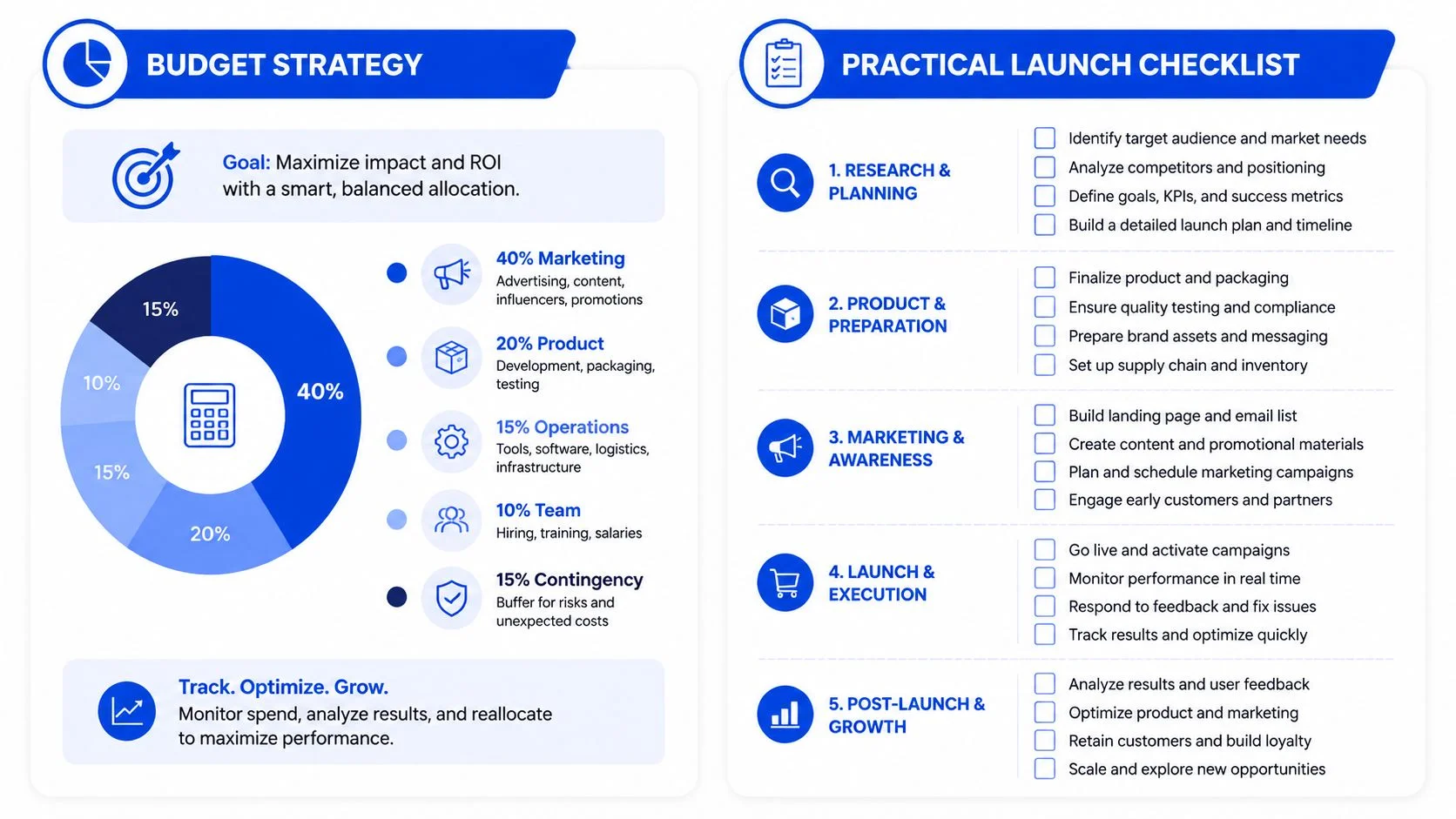
A small business doesn’t need a giant campaign structure. It needs enough budget to test a clear hypothesis, enough conversion volume to identify useful signals, and enough patience to avoid killing an ad because of one noisy day.
For the initial learning period, set the budget at roughly three to five times the target CPA per ad set. The target CPA must come from the business model. A contractor should calculate what a qualified booked job can support, while a professional services firm should work backward from close rate, gross margin, and expected client value.
Choose a budget structure
Daily budgets provide control when lead volume, staffing, or service capacity changes often. Lifetime budgets are useful for a fixed promotion or event where the platform can distribute spend across a defined campaign window.
Keep the structure consolidated enough for each ad set to receive meaningful delivery. Too many small ad sets divide the budget and make every result less reliable. Use campaign-level budgets when the platform can shift spend toward better-performing ad sets without violating geography, audience, or service constraints.
A useful pre-launch checklist includes:
- Tracking: Confirm browser and server-side events fire correctly and don’t duplicate.
- Conversion definition: Name the event that matters, such as qualified inquiry, booked appointment, or completed purchase.
- Creative mix: Include distinct hooks, formats, proof assets, and offers rather than minor text edits.
- UTMs: Label campaign, audience, creative, and placement so analytics can reconcile traffic.
- CRM workflow: Assign leads, alert the owner, and record disposition consistently.
- Hypothesis: Write down who the campaign targets, what problem it addresses, and why the offer should change behavior.
- Capacity: Confirm someone can answer calls, reply to forms, and schedule appointments during the campaign.
Scale with guardrails
Wait for a stable pattern across several comparable days before increasing spend. Increase budgets gradually, watch cost per qualified outcome, and check whether frequency is rising while response quality falls. Refresh creative when the audience has seen the same promise too often, not only after performance collapses.
For service operators, content ideas often come from real customer questions. An HVAC and plumbing blog can provide topic prompts for troubleshooting videos, seasonal explanations, and objection-handling posts, but the final creative should still reflect the company’s actual services and local proof.
Pause an ad when its customer acquisition cost exceeds the breakeven amount the owner documented before launch. Don’t pause solely because clicks are expensive if qualified appointments are profitable, and don’t continue because leads are cheap if the sales team can’t turn them into revenue.
The practical workflow is straightforward: define the economic limit, launch a focused test, verify the events, compare platform signals with CRM outcomes, and move budget only toward campaigns the business can defend.
Queen City Digital builds conversion-focused websites, paid social campaigns, tracking systems, and ongoing optimization for local and regional service businesses. If you need to connect Meta, TikTok, or LinkedIn spend to qualified leads and revenue, visit Queen City Digital to discuss a practical campaign and measurement plan.
Authored using Outrank


