
You've got a business to run, customers waiting, and a social media calendar that keeps staring back at you. Maybe you're posting from the parking lot between appointments, handing a Canva template to an employee, or paying someone to publish content across channels you rarely check. The account looks active, but you can't say which post generated a call, booking, consultation, or sale.
That's the problem with most social media management services for small business. Owners often buy activity, then discover they needed attribution, follow-up, and a clear path from attention to revenue. A better provider starts with the business outcome, builds the tracking first, and only then decides which platforms deserve your time and budget.
Table of Contents
- Why Most Small Businesses Buy the Wrong Social Media Help
- What Social Media Management Services Actually Include
- Typical Pricing Models and What Each Tier Really Delivers
- Choosing the Right Platforms for Your Buyer
- Less Is More When It Comes to Platform Count
- Response Time and Engagement Standards to Demand
- Measuring Real Results Instead of Vanity Metrics
- Agency Versus Freelancer Versus In-House
Why Most Small Businesses Buy the Wrong Social Media Help
A Charlotte bakery owner can spend the morning decorating a wedding cake, answer supplier messages at lunch, and still feel obligated to create an Instagram post before closing. She hires help because the account needs consistency. Six months later, the feed has polished photos and plenty of likes, but she still can't identify a new catering order that came from social media.
That scenario is common because social media work feels productive even when it isn't commercially useful. A scheduled post creates visible output. A campaign report filled with reach and impressions looks substantial. The less visible work, such as building a catering landing page, tagging links, answering DMs quickly, and asking every new inquiry how they found the business, determines whether the activity produces revenue.
Practical rule: Don't buy a number of posts until you know which customer action those posts are supposed to create.
Small businesses have embraced social platforms, but many still manage them through scattered internal effort. A 2024 U.S. survey found that 84% of small-to-midsize businesses used Facebook to promote products and services, while 67% used Instagram for the same purpose. The survey also identified Facebook and Instagram as the most popular platforms overall among SMBs, which helps explain why local businesses feel pressure to maintain an active presence there. The survey summary shows why management is now an operating responsibility, not a side experiment.
The staffing pattern makes the buying problem clearer. One 2025 survey reported that 56.1% of small-business respondents used in-house marketing teams, 38.3% relied on founders or CEOs, 16.8% used dedicated social media managers, and 6.6% used external agencies. Another SMB report found that only 36% had a strategic social media plan, while 79% managed social internally. Those findings point to a market that often buys posting assistance before it buys strategy.
Before signing a contract, ask three questions:
- What action should social generate? Calls, bookings, quote requests, store visits, email signups, or something else?
- Where will that action be recorded? A CRM, form, phone system, booking tool, or point-of-sale process?
- Who owns the follow-up? A social manager can start the conversation, but your team must close the opportunity.
A useful provider works backward from those answers. It may recommend fewer channels, a smaller content volume, and more attention to tracking. That approach can look less impressive on an invoice, but it gives you a chance to judge social media by business results instead of busyness. For a practical comparison of outsourced creation and owner-led posting, review social media content creation versus DIY and what drives better ROI.
What Social Media Management Services Actually Include
A social media management service usually contains three separate jobs. Providers often bundle them together, but you should evaluate each layer independently because a package that handles content may not handle customer conversations or conversion tracking.
The content layer
This is the part most owners see. It can include audience research, positioning, a content calendar, copywriting, graphic design, short-form video, Reels or TikTok production, platform-native captions, hashtag research, search optimization, approvals, and scheduling.
The quality question isn't “How many posts do I get?” It's “What does each post help a buyer understand or do?” A plumber may need emergency-service education, proof of workmanship, and a clear call option. A medical practice may need approachable explanations, provider introductions, and appointment pathways. A B2B manufacturer may need technical demonstrations and buyer education rather than daily promotional graphics.
Content production can happen internally, through a freelancer, or through a specialized partner. If you're comparing workflows and deliverables, Queen City Digital's content creation service is one example of how content can connect to broader website and campaign needs.
The community layer
Publishing doesn't finish the job. Community management covers comment moderation, direct-message responses, review responses, mention monitoring, and proactive interaction with customers, local organizations, partners, and relevant groups.
This layer needs clear authority boundaries. A provider should know which questions it can answer, which offers are approved, when to move a conversation into a private channel, and when an owner or manager must step in. A thoughtful social media strategy guide from ClipCreator.ai can help you assess how planning, publishing, engagement, and measurement fit together, but your contract still needs to specify who responds and how quickly.
The paid layer
Paid social management includes audience development, campaign setup, creative testing, retargeting, budget pacing, conversion events, and coordination with landing pages. It can also involve separating prospecting from existing-customer campaigns, testing different offers, and excluding people who already converted.
Analytics setup is where many packages become vague. Ask specifically whether the provider will configure UTM tracking, connect forms and booking tools, define conversion events, and route leads to the right person. Also confirm that your business owns the social profiles, ad accounts, pixels, audiences where platform rules allow, creative files, and reporting history.
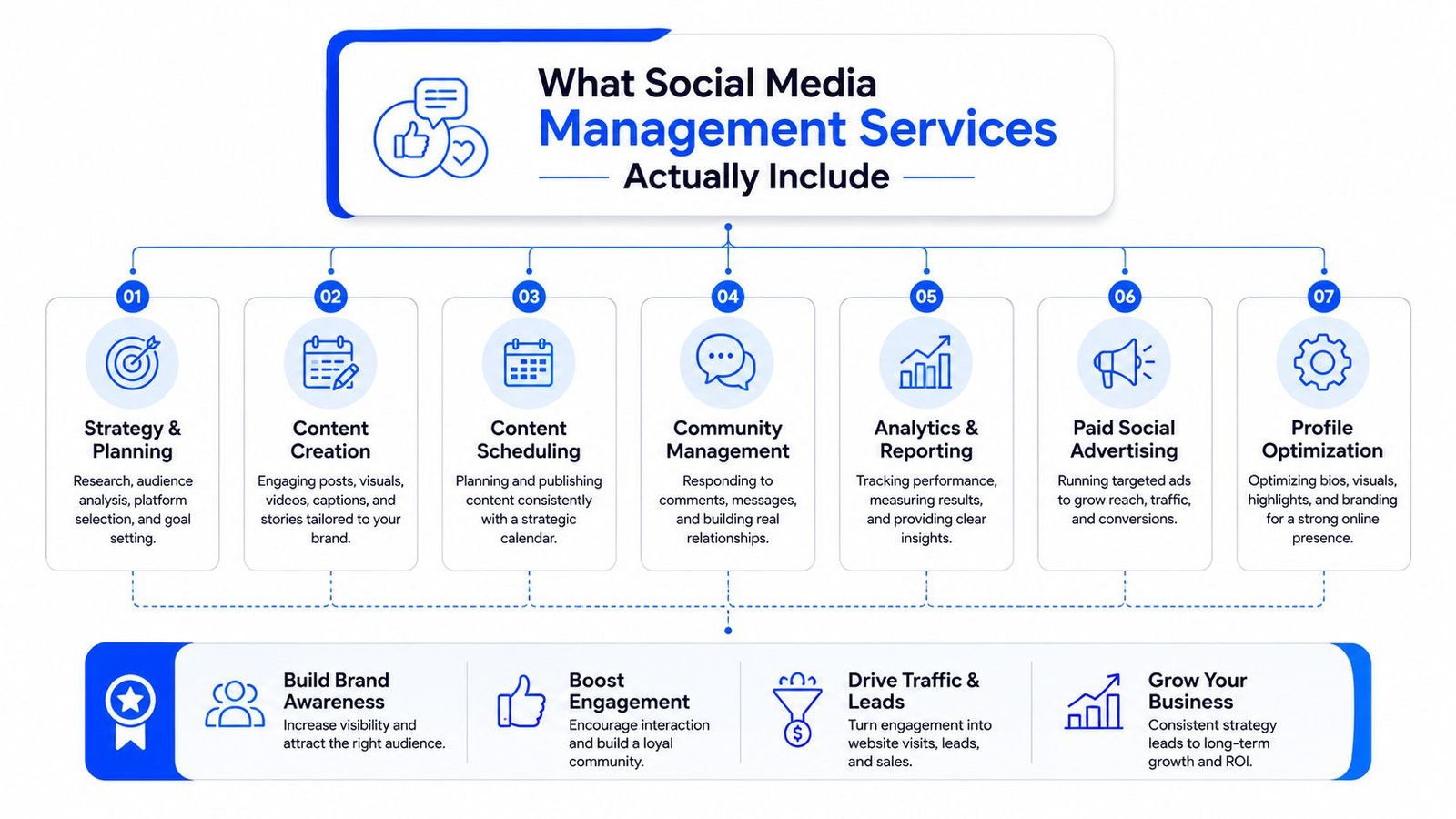
A basic package may include content and light moderation. Video shoots, paid campaigns, advanced reporting, landing-page work, and after-hours response coverage often cost extra. That's acceptable if the scope is explicit. It isn't acceptable when a provider calls a scheduling package “full service” while leaving lead tracking and customer response to you.
Typical Pricing Models and What Each Tier Really Delivers
Pricing varies by market, specialization, content demands, and whether paid media is included. The important distinction isn't the retainer itself. It's what work the retainer funds and what work remains outside the agreement.
| Tier | Monthly Price Range | Typical Deliverables | Best For | What It Often Misses |
|---|---|---|---|---|
| Solo freelancer | $500 to $1,500 | 8 to 12 posts, light community management, monthly reporting | One primary platform and a clear content source | Paid media, original video, deep attribution |
| Boutique agency | $1,500 to $5,000 | Strategy, creative production, multi-platform scheduling, community management | Businesses needing a coordinated operating system | Consistent depth across every channel, CRM follow-through |
| Full-service retainer | $5,000 to $15,000 or more | Paid media, video shoots, dedicated strategy, broader campaign support | Larger teams with complex acquisition needs | Efficient use of budget for a smaller operation |
| Project engagement | Varies by scope | Launch campaign, brand refresh, content batch, or product promotion | A defined initiative with a clear finish line | Ongoing response, optimization, and reporting continuity |
The freelancer tier can be sensible when you already have strong photography, a responsive internal team, and one platform worth prioritizing. It becomes fragile when the same person is expected to create strategy, film video, manage ads, respond to every message, and explain revenue impact.
Boutique agencies add coordination, but “multi-platform” doesn't automatically mean useful. You may receive more content while still lacking properly tagged links, lead-source questions, or a reporting view that connects social activity to booked work.
Full-service retainers can include the attribution wiring smaller providers skip, but many small businesses don't need every production capability at once. A local service company might gain more from a focused content system, reliable response coverage, and a tracked landing page than from a large video operation.
The most expensive social package is the one that produces work nobody can connect to a customer.
My candid view is that many SMBs are oversold on channel coverage and undersold on measurement. Before approving a higher tier, ask for the exact reporting fields, conversion events, response responsibilities, and optimization decisions included each month. If the provider can't show how the package will change what you do with the data, you're probably buying production rather than management.
Choosing the Right Platforms for Your Buyer
A platform isn't valuable because your competitor uses it. It's valuable when your buyer asks questions there, notices proof there, and can take the next step without friction.
Instagram fits visually led discovery. Restaurants, retailers, salons, fitness studios, designers, and hospitality businesses can use Reels, carousels, Stories, and customer content to show the experience. The trade-off is production intensity. Strong visual work needs real source material, not endless graphics.
Facebook remains practical for local service businesses, community conversations, event promotion, and audiences that use neighborhood groups or business pages for recommendations. It's often a better home for local proof, seasonal offers, and customer questions than owners assume.
LinkedIn makes sense for B2B services, industrial companies, professional firms, and consultative sales. The content that earns attention is usually practical expertise, an informed point of view, project insight, or a clear explanation of a costly problem. A company page alone may not carry the message. Leadership participation often matters.
TikTok can support discovery for businesses with a strong personality, visual process, or repeatable educational format. It asks for a steady supply of native video and a willingness to test creative quickly. Don't choose it because it's popular. Choose it if your team can make content that belongs there.
YouTube works as a search and education library. It suits businesses that can explain services, answer buying questions, demonstrate products, or build trust through longer video. The production load is heavier, but useful videos can continue supporting discovery after publication.
| Platform | Buyer profile | Best content format | Typical CPL range | Production load |
|---|---|---|---|---|
| Visual and experience-led buyers | Reels, carousels, Stories | Not specified | Medium to high | |
| Local consumers and community-oriented buyers | Local proof, offers, short video, community posts | Not specified | Medium | |
| B2B buyers and professional decision-makers | Expertise posts, case explanations, founder content | Not specified | Medium | |
| TikTok | Discovery-oriented buyers who respond to native video | Short educational or personality-led video | Not specified | High |
| YouTube | Buyers researching solutions in depth | Demonstrations, explainers, FAQs | Not specified | High |
The table leaves cost per lead qualitative on purpose. Your CPL depends on offer, geography, conversion path, audience, creative, and follow-up quality. Anyone promising a universal benchmark without seeing your funnel is selling confidence, not analysis.
Start where your buyer already asks for recommendations. Then build a conversion path before adding another channel. If paid campaigns are part of the plan, use paid social advertising guidance for campaign structure and tracking to keep the media decision tied to the landing page and lead process.
Less Is More When It Comes to Platform Count
“Be everywhere” is convenient advice for a provider selling a broad package. It's usually poor advice for an owner with limited source material, limited approval time, and limited response capacity.
Benchmark summaries indicate that LinkedIn and Instagram often find a workable balance around 3 to 5 posts per week, while Facebook often performs better at 1 to 2 posts per day. The same benchmark guidance warns that inconsistent frequency can reduce visibility, while excessive volume can produce diminishing returns. The platform cadence benchmarks support a simple conclusion: consistency and format fit matter more than filling every available profile.
A small business can create one useful idea and adapt it across two channels. It struggles when that idea must become a different native asset for four or five channels, then requires separate comments, DMs, approvals, and reporting. The content calendar expands, but the owner's attention doesn't.
Use a subtraction test before expanding:
- Review the last 60 days: Look for tracked leads, booked calls, store visits, or meaningful inquiries by channel.
- Cut unsupported channels: If a platform has produced no tracked business action and requires ongoing effort, pause it.
- Reinvest the hours: Improve the channel where buyers respond, the offer where they convert, or the follow-up that closes the opportunity.
Don't confuse a quiet channel with a failed channel if you haven't installed tracking. Fix attribution first, then judge performance. But once the measurement exists, stop protecting channels because they're familiar.
A focused two-platform presence with current information and active replies will usually serve a local business better than five neglected profiles. Your provider should be willing to remove a channel when the evidence says it isn't earning its place.
Response Time and Engagement Standards to Demand
A prospective customer who comments or sends a DM is giving you a live opportunity. Leaving that person waiting while the provider prepares next month's content calendar is a service failure.
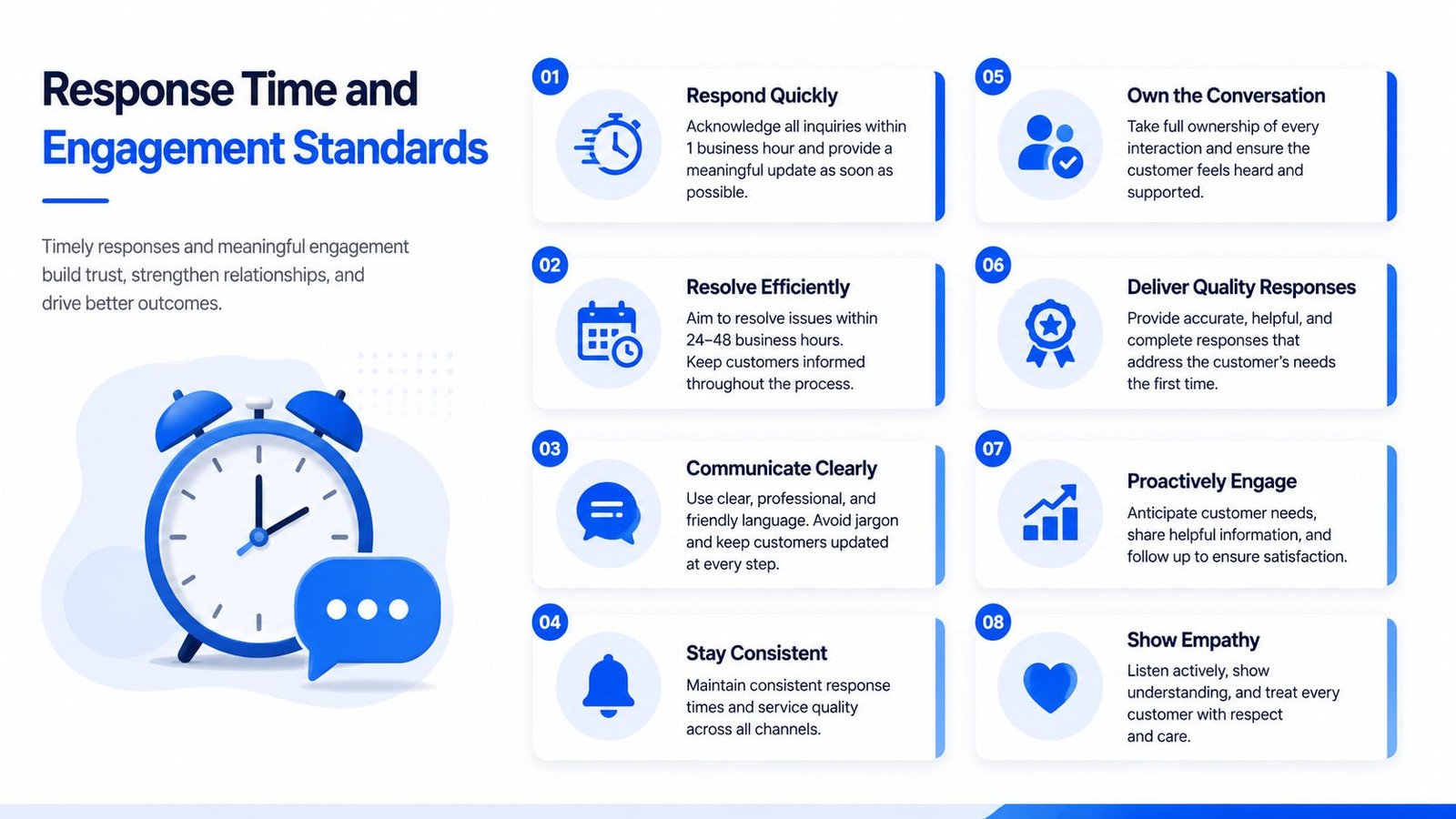
Social customer-service benchmarks cluster around a 60-minute first-response target, with best-in-class teams responding in about 15 minutes, while average brands can take 4 to 5 hours on social channels. The response-time benchmark summary explains why your agreement should define coverage rather than just promise “community management.”
Set standards in writing:
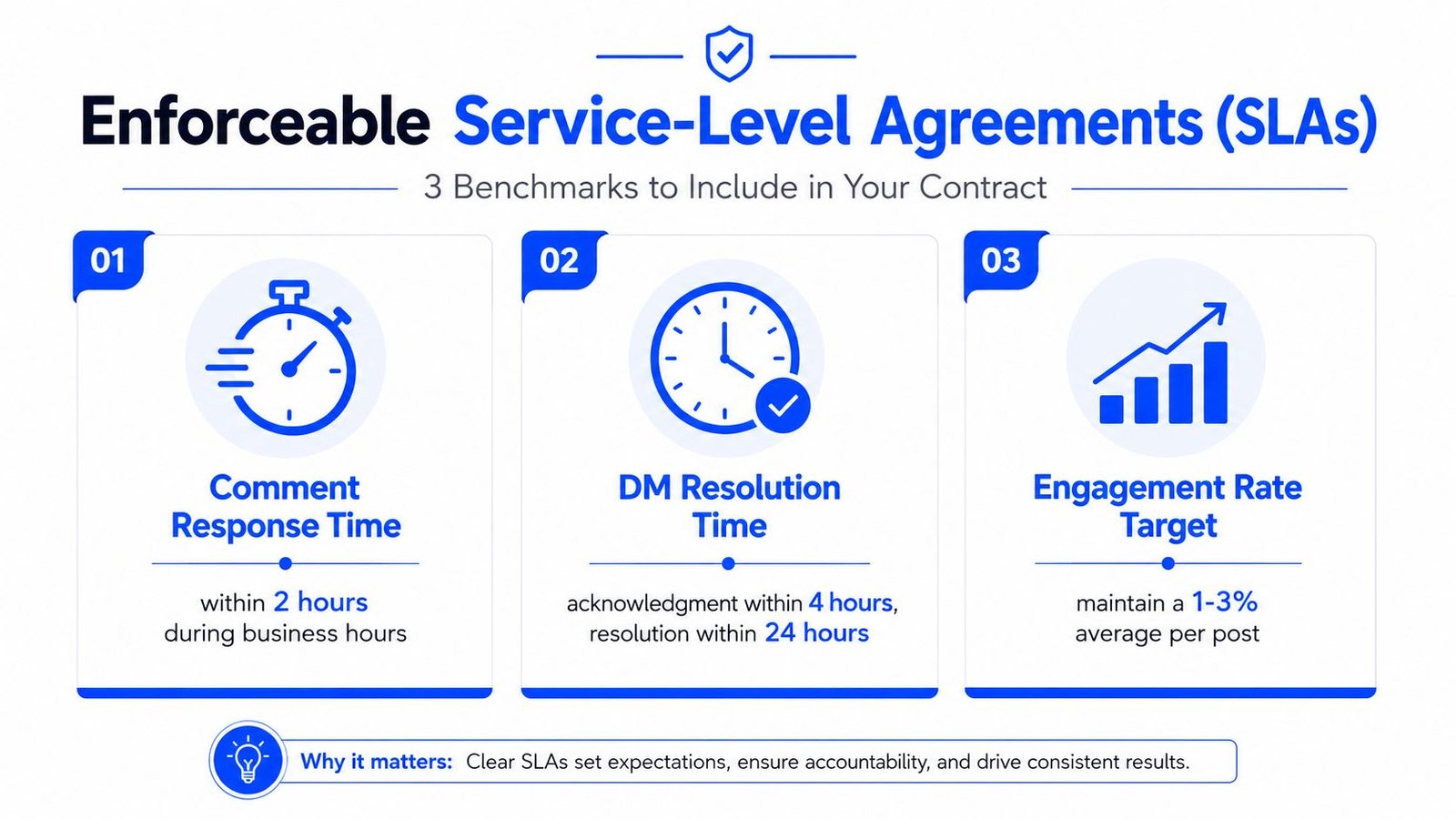
- Comments: Acknowledge relevant comments within one hour during covered business hours.
- Direct messages: Send an initial response within four hours, then resolve or route the inquiry within the agreed business process.
- Complaints: Escalate serious complaints, safety issues, billing disputes, and negative reviews to a named owner or manager the same day.
- Reporting: Provide weekly channel-level engagement and response data, plus a monthly review tied to leads and customer actions.
The agreement should identify the business hours, excluded holidays, escalation contact, approval boundaries, and response templates. It should also state what happens when the provider can't answer a question. “We'll get back to you” is better than a fabricated answer, but the handoff must be tracked.
Metrics that deserve attention
Likes and follower counts can provide context, but they shouldn't dominate the report. Ask for reply rate, saves, link clicks, landing-page sessions, form starts, calls, bookings, and lead-source results. A post with modest public engagement can still matter if it reaches the right buyer and produces a qualified inquiry.
Contract language: “Provider will report response performance by channel each month, document escalations, and participate in a monthly review of tracked business outcomes.”
Add a performance review and a reasonable exit or adjustment process. A provider that refuses measurable response standards or clear reporting isn't protecting flexibility. It's avoiding accountability.
Measuring Real Results Instead of Vanity Metrics
A social report can show reach, likes, and follower growth while your sales team receives no additional opportunities. That doesn't make engagement useless. It means engagement is an intermediate signal, not the financial result you hired the provider to create.
Start with a simple attribution chain:
- Tag the traffic: Use UTM-tagged links for social posts, profile links, ads, and campaign variations.
- Give social a destination: Send traffic to a dedicated landing page, tracked form, booking flow, phone number, or offer code.
- Audit lead sources: Ask every new inquiry how they found you, then compare the answer with analytics and CRM records each month.
A Charlotte plumber may define a good social month as a clear increase in qualified service inquiries from a tracked local offer. A boutique fitness studio may care about trial signups and attended consultations. A B2B consultant may value fewer but better-fit conversations that enter a sales pipeline. The provider should help define those outcomes before publishing begins.
| Business Type | Vanity Metric | Business Metric | Tracking Method |
|---|---|---|---|
| Local plumber | Reach and video views | Tracked calls and quote requests | UTM landing page, call tracking, CRM source field |
| Boutique fitness studio | Likes and follower growth | Trial bookings and attended visits | Booking form, campaign link, intake question |
| B2B consultant | Impressions and post reactions | Qualified discovery calls | UTM links, form attribution, CRM opportunity source |
A useful report answers four plain-English questions: what happened, why it happened, what it produced, and what changes next month. These social media measurement tips from Captapi offer additional context for organizing the reporting layer.
Watch for warning signs. The provider may hide behind vanity metrics if the report never shows landing-page activity, lead quality, response performance, campaign spend, or closed-loop feedback from your team. It may also report every channel together, making it impossible to see where the useful action occurred.
Your reporting system doesn't need to be elaborate. It needs consistent naming, reliable source fields, and a monthly conversation about what the data says. Analytics and reporting support from Queen City Digital is one example of a service focused on connecting marketing activity to decision-ready measurement.
Agency Versus Freelancer Versus In-House
The right operator depends on your content demands, response expectations, internal expertise, and tolerance for management overhead. A cheap model becomes expensive when you must supply all the strategy, raw material, approvals, and follow-up yourself.
| Model | Typical Monthly Cost | Strengths | Weaknesses | Best Fit For |
|---|---|---|---|---|
| Full-service agency | Varies by scope | Broad capabilities, paid media, analytics, creative, strategy | Can overpromise reach and underdeliver on response depth | Businesses needing connected campaigns |
| Boutique social specialist | Varies by scope | Focused content and community expertise | May lack web, CRM, or paid search capabilities | Businesses prioritizing social execution |
| Freelancer | Varies by scope | Personal attention, flexible scope, lower overhead | Single point of failure, limited capacity | One or two channels with a strong internal contact |
| In-house hire | Varies by compensation and overhead | Deep product knowledge, daily access to the team | Requires management, training, tools, and backup coverage | Businesses with substantial ongoing content and response needs |
| Hybrid model | Varies by split of work | External strategy with internal authenticity and access | Responsibilities can blur without documentation | Growing service businesses with internal subject-matter experts |
Full-service agencies
An agency can connect social content with landing pages, search campaigns, paid media, local SEO, reputation management, and analytics. That breadth matters when social is one part of a larger lead-generation system. The risk is distance. Some agencies sell impressive reach projections but assign community replies to a junior team member who doesn't understand your customers.
Ask to meet the person who will write, publish, monitor, and report. Don't accept a senior strategist in the sales call and an unnamed production queue after signing.
Boutique specialists
A focused social firm may be excellent at visual production, platform-native creative, and daily engagement. It can be the right choice for a restaurant, retail shop, or personality-led brand with a steady supply of original material.
The limitation is integration. If the firm doesn't configure tracking or coordinate with your website and CRM, you may receive a strong social presence without a reliable revenue view.
Freelancers
A freelancer can work well when you need one channel managed consistently and you have a responsive business contact supplying expertise, offers, photos, and approvals. The relationship is direct, and the scope can stay practical.
The weakness is continuity. Illness, competing client deadlines, or a sudden change in capacity can interrupt your publishing and response coverage. Require a documented content system, account access protocol, and backup plan.
In-house hiring
An employee gains daily context and can capture real customer questions, staff expertise, and behind-the-scenes material. That can produce more authentic content than a remote provider receives from a folder of old photos.
In-house doesn't mean free. You still need strategy, training, design and video tools, analytics, paid-media knowledge, management time, and coverage when the employee is unavailable. Hire internally when the workload is persistent enough to justify a role, not because social feels too important to outsource.
The hybrid option
For a service business with meaningful internal expertise, hybrid often makes sense. An outside partner can define the channel plan, tracking model, campaign structure, and reporting process, while your team supplies job-site footage, professional insight, customer questions, and approval decisions.
That arrangement preserves authenticity without forcing the owner to become a full-time content manager. It also makes it easier to reduce platforms when the evidence doesn't support them. If you're comparing practical outsourced models, this guide to affordable marketing agencies can help frame the conversation around scope and business needs.
Ten questions for prospective providers
- Which business outcome will you optimize first?
- How will you track calls, forms, bookings, or store visits?
- Who writes and approves the actual content?
- Who responds to comments and DMs?
- What response time applies during business hours?
- How do you escalate negative reviews or sensitive complaints?
- What will the monthly report show beyond reach and likes?
- Will you recommend reducing platforms when the data supports it?
- Who owns the accounts, ad assets, creative files, and tracking setup?
- What performance review and exit terms are included?
Treat guaranteed follower growth, vague dashboards, no named point of contact, unclear ownership, and contracts longer than six months without a performance clause as serious red flags. A provider should be able to explain what it controls, what it needs from you, and what it will change when results fall short.
A practical 30-day ramp
Days 1 to 7: Audit every active profile, record current lead paths, identify the channels your buyers use, and document who currently handles replies.
Days 8 to 14: Choose one revenue-linked goal, install UTM conventions, connect forms or booking tools, and define response and escalation rules.
Days 15 to 21: Request proposals from providers that can explain their measurement process. Compare scope, ownership, response coverage, reporting, and cancellation terms, not just post counts.
Days 22 to 30: Select a focused starting scope and negotiate a 60-day pilot. Review the first month for execution quality and tracking integrity, then judge the second month for qualified actions and useful learning before expanding.
The right social media management services for small business won't make your company look busy everywhere. They'll make the chosen channels easier to operate, easier to measure, and easier to connect to the customers you want.
Queen City Digital helps Charlotte-area businesses plan social content, manage community engagement, run paid social campaigns, and connect activity to lead-generation analytics. Visit Queen City Digital to discuss a focused social media plan built around your buyers, response capacity, and revenue goals.